DTS: Delta-Based Tile Scoring for Efficient Long-Context Sparse Attention
Abstract
Large language models (LLMs) increasingly need to process long documents and codebases, making long-context attention a major prefill bottleneck. Block sparse attention reduces computation by skipping unimportant blocks of the attention matrix, but scoring blocks accurately can itself be expensive. We propose Delta-Based Tile Scoring (DTS), a training-free, content-adaptive tile scoring method for sparse block attention. DTS selects query and key anchors according to local vector changes, using fewer representatives in redundant regions while retaining more detail in heterogeneous regions. To accelerate anchor selection, parallel delta packing partitions the query and key sequences into tile-aligned chunks and performs bounded local scans over these chunks concurrently. The selected tiles are then computed using the original query, key, and value vectors. On LLaMA-3.1-8B-Instruct, DTS keeps average RULER and LongBench scores within 0.10 percentage points of full attention, with RULER evaluated up to 128K tokens. At 128K tokens, DTS reduces measured scoring-pipeline latency by 38% compared with XAttention. On four NVIDIA H100 GPUs, it achieves a 3.3$\times$ prefill speedup over a PyTorch full-attention baseline using FlashAttention-2 at 512K tokens.
Analysis
AI-generated · verify against the original paper
Generated Jan 1, 0001ResultsWhat the authors found
- On LLaMA‑3.1‑8B‑Instruct, DTS keeps average RULER and LongBench scores within 0.10 percentage points of full attention up to 128K tokens.
- At 128K tokens, DTS reduces scoring‑pipeline latency by 38% compared with XAttention.
- Across four NVIDIA H100 GPUs, DTS achieves a 3.3× prefill speedup over a PyTorch full‑attention baseline using FlashAttention‑2 at 512K tokens.
- DTS attains the highest LongBench average score of 47.51 (τ=0.72) on LLaMA, within 0.02 points of full attention and 1.01–1.04 points above XAttention.
- Ablation studies show parallel delta packing accelerates packing by 18.5–24.6× and that the cosine‑threshold τ=0.72 yields the best speedup‑accuracy trade‑off.
LimitationsWhere the findings need caution
- Scoring‑pipeline latency remains a bottleneck at the longest contexts, as tile scoring, selection, and sparse attention dominate total latency.
- The method requires offline calibration of per‑head tile‑selection thresholds, which may need re‑tuning for different models or hardware.
MethodologyHow the work was done
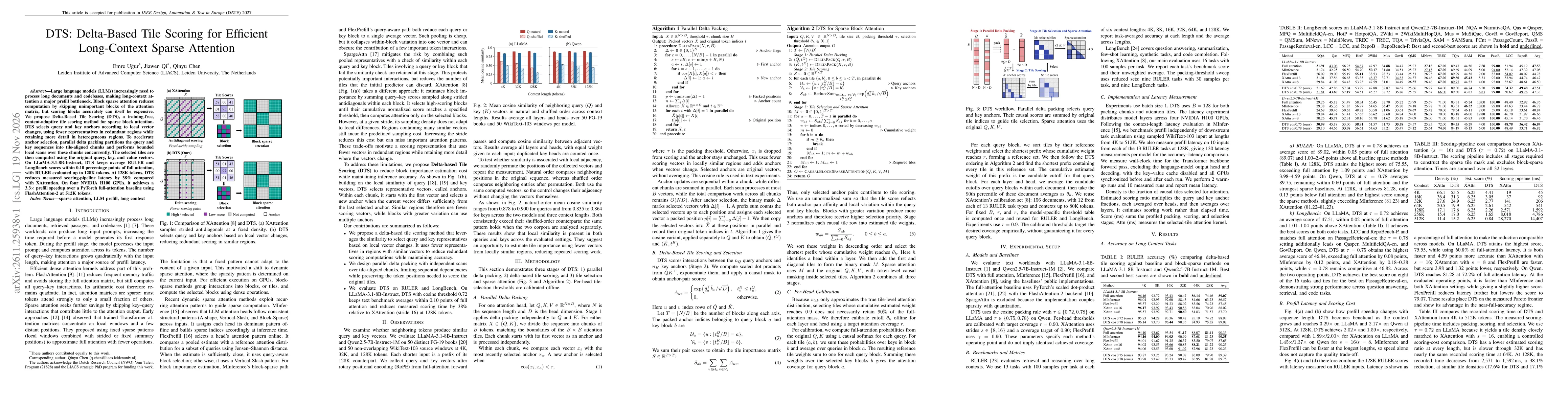
DTS consists of three stages: (1) Parallel Delta Packing, which partitions query and key sequences into tile‑aligned chunks and scans each chunk independently to select anchors based on cosine similarity thresholds; (2) Delta‑Based Tile Scoring, which uses the selected anchors to represent query and key vectors, reducing redundant scoring in locally similar regions while preserving detail in heterogeneous regions; (3) Tile Selection and Sparse Attention, where the chosen tiles are processed with the original Q, K, V matrices using block‑sparse attention.
SignificanceWhy the work matters
DTS demonstrates that content‑adaptive, training‑free tile scoring can dramatically cut the quadratic cost of long‑context attention while preserving near‑full‑model accuracy, enabling practical inference for very long prompts on large language models.
Technical contributionsWhat the work introduces
Introduces a delta‑based tile scoring mechanism that selects query and key anchors according to local vector changes and parallelizes the anchor selection via delta packing across tile‑aligned chunks, providing a training‑free, content‑adaptive sparse attention scheme.
NoveltyHow it differs from prior work
First to exploit local cosine similarity of query/key vectors to adaptively reduce scoring density, replacing fixed sparse patterns (e.g., strided antidiagonals) with dynamically chosen anchors and parallel delta packing for efficient execution.
Discussion 0