DuetSVG: Unified Multimodal SVG Generation with Internal Visual Guidance
Abstract
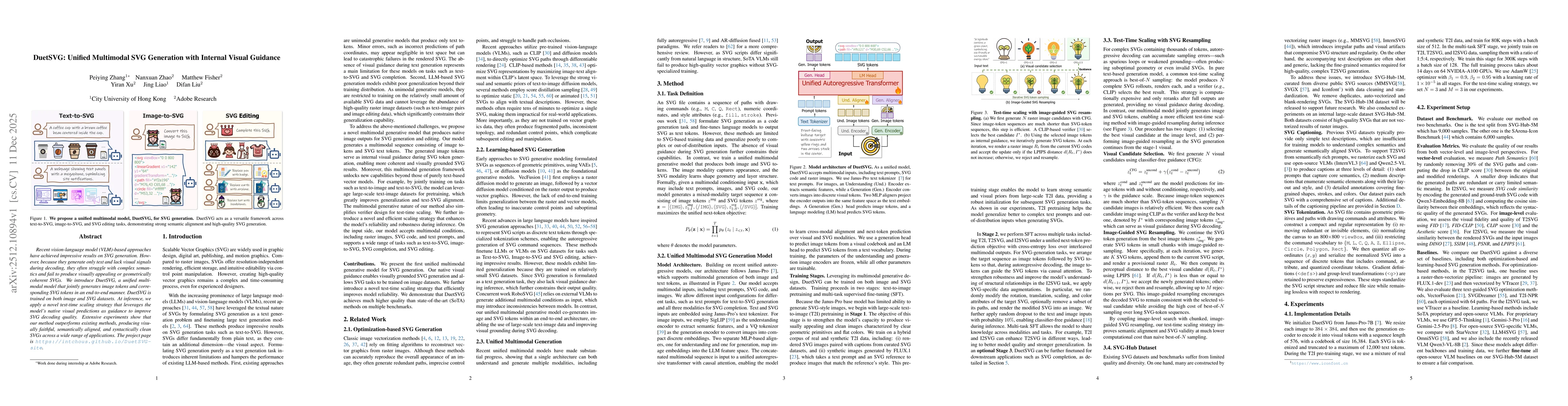
Recent vision-language model (VLM)-based approaches have achieved impressive results on SVG generation. However, because they generate only text and lack visual signals during decoding, they often struggle with complex semantics and fail to produce visually appealing or geometrically coherent SVGs. We introduce DuetSVG, a unified multimodal model that jointly generates image tokens and corresponding SVG tokens in an end-to-end manner. DuetSVG is trained on both image and SVG datasets. At inference, we apply a novel test-time scaling strategy that leverages the model's native visual predictions as guidance to improve SVG decoding quality. Extensive experiments show that our method outperforms existing methods, producing visually faithful, semantically aligned, and syntactically clean SVGs across a wide range of applications.
Analysis
AI-generated · verify against the original paper
Generated Dec 12, 2025ResultsWhat the authors found
- DuetSVG achieves 99.5% Novelty and 99.8% Uniqueness on the SVG-Hub-5M dataset
- The model outperforms prior approaches across multiple metrics including FID, CLIP, and SSIM
- The TTS (Text-to-SVG) method significantly improves generation quality compared to baseline models
LimitationsWhere the findings need caution
- Fine details and color consistency may be lacking in complex images
- The model struggles with very detailed or highly colorful inputs
MethodologyHow the work was done
The research introduces DuetSVG, a unified multimodal model that generates SVGs using internal visual guidance. It combines text and image inputs through an end-to-end architecture, leveraging large-scale text-image data and visual grounding during SVG decoding.
SignificanceWhy the work matters
This research advances SVG generation by enabling more natural and diverse outputs through multimodal understanding. It has potential applications in graphic design, icon creation, and automated illustration generation.
Technical contributionsWhat the work introduces
The technical contribution lies in the unified multimodal architecture that co-generates image and SVG tokens, along with the use of large-scale text-image data and visual grounding during decoding.
NoveltyHow it differs from prior work
The novelty is in the internal visual guidance mechanism that enables the model to generate SVGs while maintaining visual consistency with the input text and images, unlike previous methods that rely on separate image-to-SVG pipelines.
Future workQuestions that remain
- Investigate dynamic high-resolution strategies for better detail capture
- Explore additional modalities and training data sources
Discussion 0