Dust Evolution in the Dwarf Galaxy Holmberg II
A study of the galaxy Holmberg II reveals that as star-forming regions age, their infrared emission shifts from hot dust grains to polycyclic aromatic hydrocarbons (PAHs), suggesting a link between PAH growth and grain destruction.
Abstract
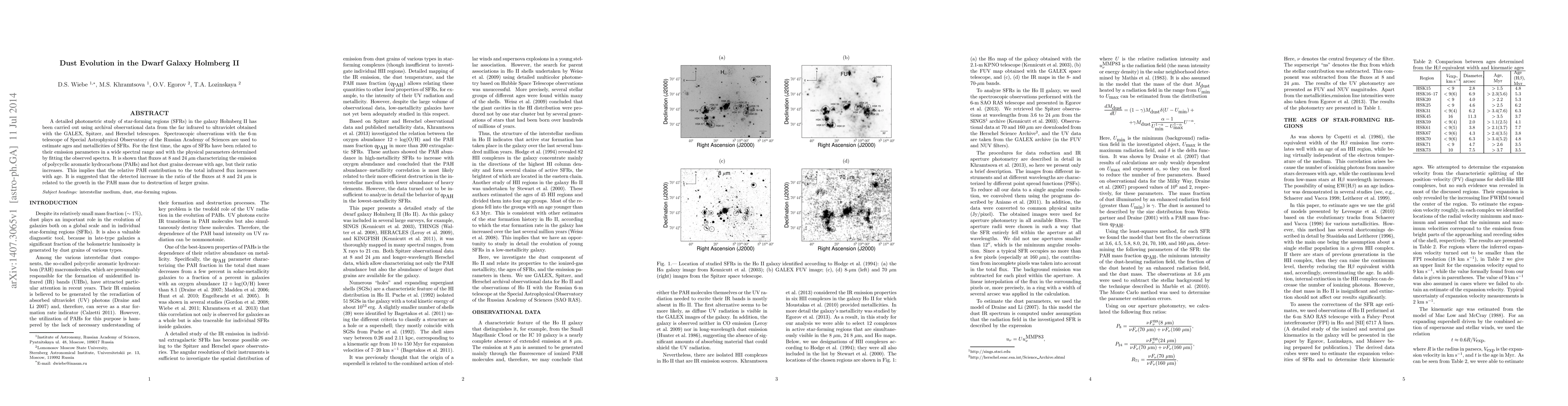
A detailed photometric study of star-forming regions (SFRs) in the galaxy Holmberg II has been carried out using archival observational data from the far infrared to ultraviolet obtained with the GALEX, Spitzer, and Herschel telescopes. Spectroscopic observations with the 6-m telescope of Special Astrophysical Observatory of the Russian Academy of Sciences are used to estimate ages and metallicities of SFRs. For the first time, the ages of SFRs have been related to their emission parameters in a wide spectral range and with the physical parameters determined by fitting the observed spectra. It is shown that fluxes at 8 and 24 micron characterizing the emission of polycyclic aromatic hydrocarbons (PAHs) and hot dust grains decrease with age, but their ratio increases. This implies that the relative PAH contribution to the total infrared flux increases with age. It is suggested that the detected increase in the ratio of the fluxes at 8 and 24 micron is related to the growth in the PAH mass due to destruction of larger grains.
AI Key Findings
Get AI-generated insights about this paper's methodology, results, significance, and more — available when analysis has been generated.
Discussion 0