Abstract
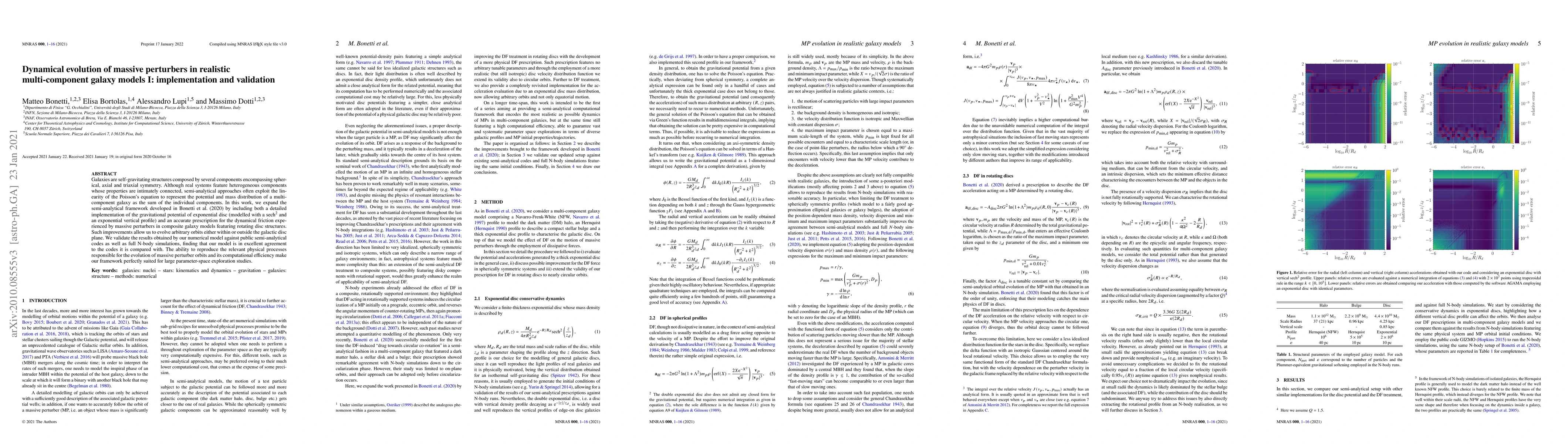
Galaxies are self-gravitating structures composed by several components encompassing spherical, axial and triaxial symmetry. Although real systems feature heterogeneous components whose properties are intimately connected, semi-analytical approaches often exploit the linearity of the Poisson's equation to represent the potential and mass distribution of a multi-component galaxy as the sum of the individual components. In this work, we expand the semi-analytical framework developed in Bonetti et al. (2020) by including both a detailed implementation of the gravitational potential of exponential disc (modelled with a ${\rm sech}^2$ and an exponential vertical profile) and an accurate prescription for the dynamical friction experienced by massive perturbers in composite galaxy models featuring rotating disc structures. Such improvements allow us to evolve arbitrary orbits either within or outside the galactic disc plane. We validate the results obtained by our numerical model against public semi-analytical codes as well as full N-body simulations, finding that our model is in excellent agreement to the codes it is compared with. The ability to reproduce the relevant physical processes responsible for the evolution of massive perturber orbits and its computational efficiency make our framework perfectly suited for large parameter-space exploration studies.
AI Key Findings
Get AI-generated insights about this paper's methodology, results, significance, and more — available when analysis has been generated.
Discussion 0