Dynamical susceptibility of a Fermi liquid
Abstract
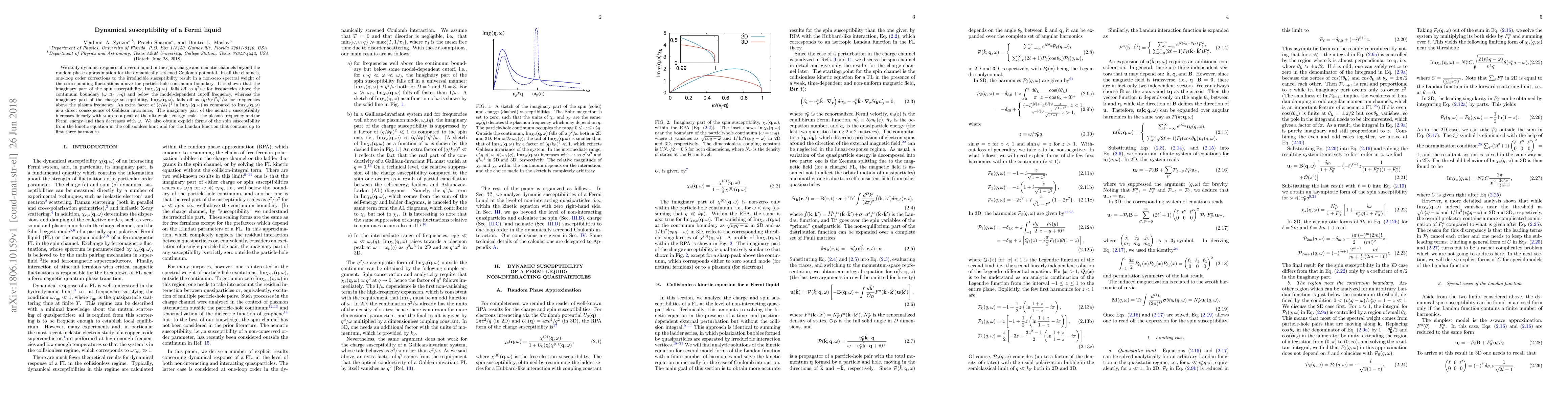
We study the dynamic response of a Fermi liquid in the spin, charge and nematic channels beyond the random phase approximation for the dynamically screened Coulomb potential. In all the channels, one-loop order corrections to the irreducible susceptibility result in a non-zero spectral weight of the corresponding fluctuations above the particle-hole continuum boundary. It is shown that the imaginary part of the spin susceptibility, $\text{Im}\chi_{s}(\bf{q},\omega)$, falls off as $q^2/\omega$ for frequencies above the continuum boundary ($\omega\gg v_{F} q$) and below the model-dependent cutoff frequency, whereas the imaginary part of the charge susceptibility, $\text{Im}\chi_c(\bf{q},\omega)$, falls off as $(q/k_F)^2 q^2/\omega$ for frequencies above the plasma frequency. An extra factor of $(q/k_F)^2$ in $\text{Im}\chi_c(\bf{q},\omega)$ as compared to $\text{Im}\chi_{s}(\bf{q},\omega)$ is a direct consequence of Galilean invariance. The imaginary part of the nematic susceptibility increases linearly with $\omega$ up to a peak at the ultraviolet energy scale-- the plasma frequency and/or Fermi energy--and then decreases with $\omega$. We also obtain explicit forms of the spin susceptibility from the kinetic equation in the collisionless limit and for the Landau function that contains up to first three harmonics.
AI Key Findings
Get AI-generated insights about this paper's methodology, results, significance, and more — available when analysis has been generated.
Discussion 0