Dynamical Vehicle Orienteering Problem for Multi-Rotor Unmanned Aerial Vehicles
The paper introduces the Dynamical Vehicle Orienteering Problem (DVOP) for 3D multi-rotor UAVs, coupling reward maximization with time-optimal trajectory planning under dynamic flight constraints. It develops two solution approaches—Branch-and-Bound using a novel MILP-based travel-cost formulation and a Large Neighborhood Search—showing up to 37% improvement over existing methods and validating trajectories on real UAV flights.
Abstract
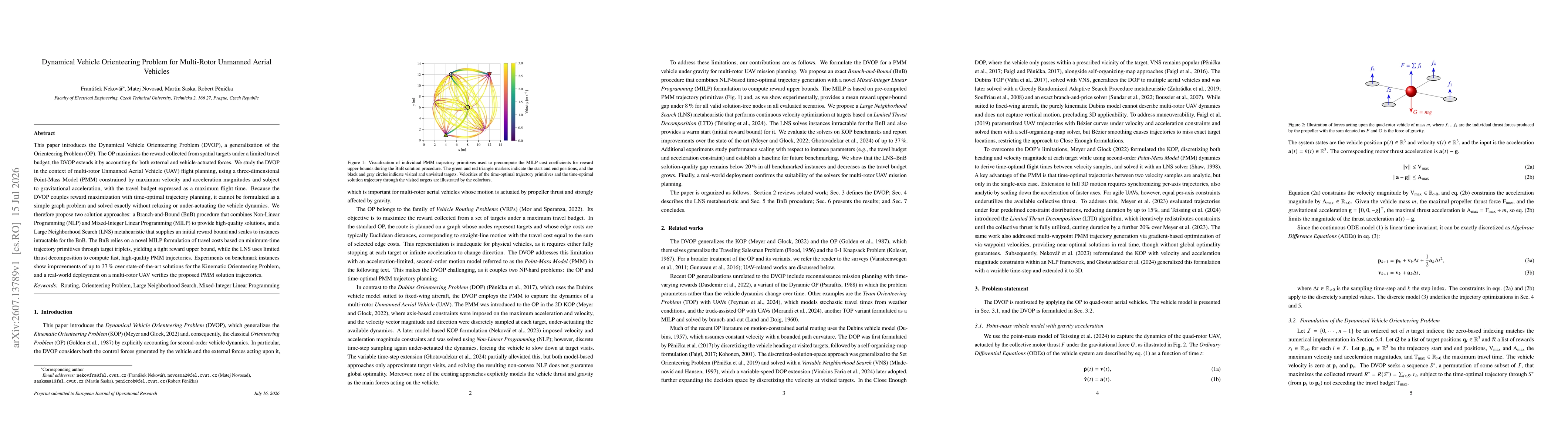
This paper introduces the Dynamical Vehicle Orienteering Problem (DVOP), a generalization of the Orienteering Problem (OP). The OP maximizes the reward collected from spatial targets under a limited travel budget; the DVOP extends it by accounting for both external and vehicle-actuated forces. We study the DVOP in the context of multi-rotor Unmanned Aerial Vehicle (UAV) flight planning, using a three-dimensional Point-Mass Model (PMM) constrained by maximum velocity and acceleration magnitudes and subject to gravitational acceleration, with the travel budget expressed as a maximum flight time. Because the DVOP couples reward maximization with time-optimal trajectory planning, it cannot be formulated as a simple graph problem and solved exactly without relaxing or under-actuating the vehicle dynamics. We therefore propose two solution approaches: a Branch-and-Bound (BnB) procedure that combines Non-Linear Programming (NLP) and Mixed-Integer Linear Programming (MILP) to provide high-quality solutions, and a Large Neighborhood Search (LNS) metaheuristic that supplies an initial reward bound and scales to instances intractable for the BnB. The BnB relies on a novel MILP formulation of travel costs based on minimum-time trajectory primitives through target triplets, yielding a tight reward upper bound, while the LNS uses limited thrust decomposition to compute fast, high-quality PMM trajectories. Experiments on benchmark instances show improvements of up to 37 % over state-of-the-art solutions for the Kinematic Orienteering Problem, and a real-world deployment on a multi-rotor UAV verifies the proposed PMM solution trajectories.
Analysis
AI-generated · verify against the original paper
Generated Jul 17, 2026ResultsWhat the authors found
- Experiments show improvements of up to 37% over state-of-the-art solutions for the Kinematic Orienteering Problem.
- The BnB with the novel MILP travel-cost formulation yields tight reward upper bounds via minimum-time trajectory primitives through target triplets.
- The LNS approach delivers fast, high-quality PMM trajectories suitable as initial seeds for BnB and handles larger instances.
LimitationsWhere the findings need caution
- Exact BnB solution requires relaxation/under-actuation considerations, which may limit applicability to highly dynamic or larger-scale problems.
- Performance depends on discretization of PMM primitives and the quality of the MILP formulation, potentially impacting scalability for very large target sets.
- Validation is shown on benchmark instances and a single real-world deployment, leaving broader field validation open.
MethodologyHow the work was done
The paper presents two complementary solution approaches for the DVOP: (1) a Branch-and-Bound (BnB) procedure that interleaves Non-Linear Programming (NLP) and Mixed-Integer Linear Programming (MILP) to compute tight upper bounds and high-quality trajectories, and (2) a Large Neighborhood Search (LNS) metaheuristic that provides initial reward bounds and scales to instances intractable for BnB by using limited thrust decomposition to generate fast PMM trajectories.
SignificanceWhy the work matters
DVOP integrates dynamics, thrust, and gravity into the orienteering framework, enabling time-optimal trajectory planning for multi-rotor UAVs beyond purely kinematic or graph-based formulations, and providing methods with practical real-world deployment potential.
Technical contributionsWhat the work introduces
A novel MILP formulation of travel costs based on minimum-time trajectory primitives through target triplets that yields tight reward upper bounds for DVOP, combined with a complementary LNS metaheuristic using limited thrust decomposition to generate fast, high-quality PMM trajectories.
NoveltyHow it differs from prior work
First to jointly model a three-dimensional PMM with gravity and thrust constraints within a dynamical, reward-based orienteering framework and to couple NLP/MILP-based BnB with an LNS metaheuristic for DVOP in multi-rotor UAV flight planning.
Future workQuestions that remain
- Extend the MILP cost-coefficient construction to handle more complex dynamics or alternative vehicle models.
- Investigate adaptive discretization strategies to improve scalability and bound tightness.
- Expand real-world experiments to diverse UAV platforms and varying environmental conditions.
Discussion 0