EDITORS Know Your Style! Editing LoRA Subspaces for Stylistic Attribution and Imitation
Abstract
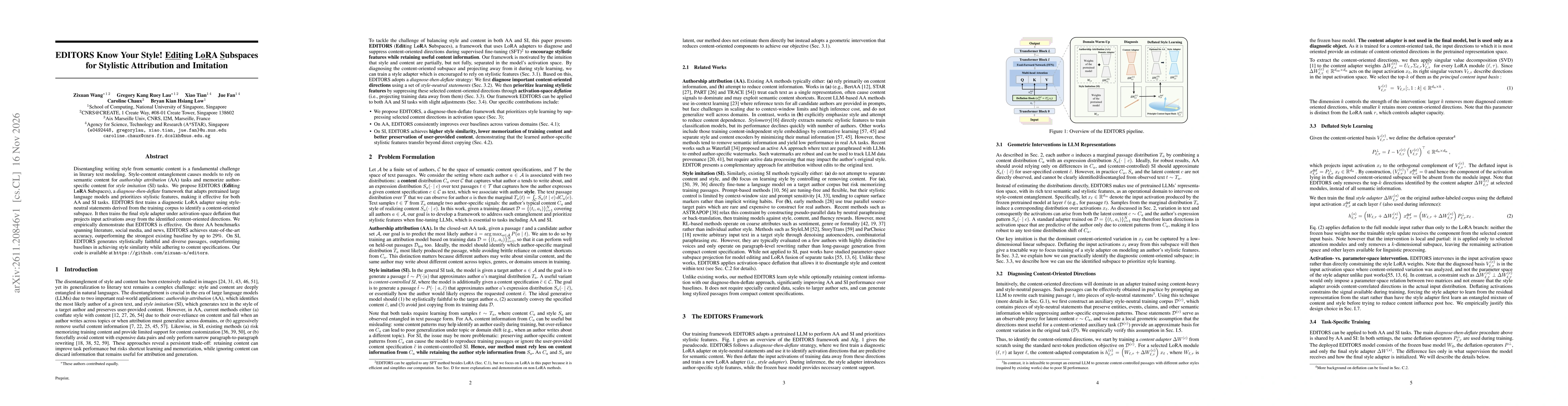
Disentangling writing style from semantic content is a fundamental challenge in literary text modeling. Style-content entanglement causes models to rely on semantic content for authorship attribution (AA) tasks and memorize author-specific content for style imitation (SI) tasks. We propose EDITORS (EditingLoRA Subspaces), a diagnose-then-deflate framework that adapts pretrained large language models and prioritizes stylistic features, making it effective for both AA and SI tasks. EDITORS first trains a diagnostic LoRA adapter using style-neutral statements derived from the training corpus to identify a content-oriented subspace. It then trains the final style adapter under activation-space deflation that projects input activations away from the identified content-oriented directions. We empirically demonstrate that EDITORS is effective. On three AA benchmarks spanning literature, social media, and news, EDITORS achieves state-of-the-art accuracy, outperforming the strongest existing baseline by up to 29%. On SI, EDITORS generates stylistically faithful and diverse passages, outperforming baselines in achieving style similarity while adhering to content specifications.
Analysis
AI-generated · verify against the original paper
Generated Jan 1, 0001ResultsWhat the authors found
- On three authorship attribution benchmarks spanning literature, social media, and news, EDITORS achieves state‑of‑the‑art accuracy, outperforming the strongest baseline by up to 29%.
- For style imitation, EDITORS generates passages that are more stylistically faithful and diverse than baselines, achieving higher style similarity while respecting content specifications.
MethodologyHow the work was done
EDITORS first trains a diagnostic LoRA adapter on style‑neutral statements to identify a content‑oriented subspace, then trains a style adapter with activation‑space deflation that projects input activations away from the identified content directions, enabling fine‑tuning of pretrained LLMs to prioritize stylistic features for both authorship attribution and style imitation.
SignificanceWhy the work matters
The framework effectively disentangles style from content, leading to substantial gains in both attribution accuracy and generation quality, and demonstrates that content‑oriented subspace suppression can improve downstream literary text tasks.
Technical contributionsWhat the work introduces
A diagnose‑then‑deflate framework that uses LoRA adapters to first identify content‑oriented activation directions and then suppresses them during style‑focused fine‑tuning, enabling simultaneous improvements in authorship attribution and style imitation.
NoveltyHow it differs from prior work
Introducing activation‑space deflation via LoRA subspaces as a principled way to disentangle style and content in large language models, a strategy not previously applied to literary text modeling.
Discussion 0