This paper reviews supergravity theories relevant to superstring cosmology, focusing on uplifting methods to create de Sitter vacua within N=1 and N=2 supergravities, utilizing superconformal techniques. Brief discussions on cosmic strings and target manifold embeddings are also included.
Abstract
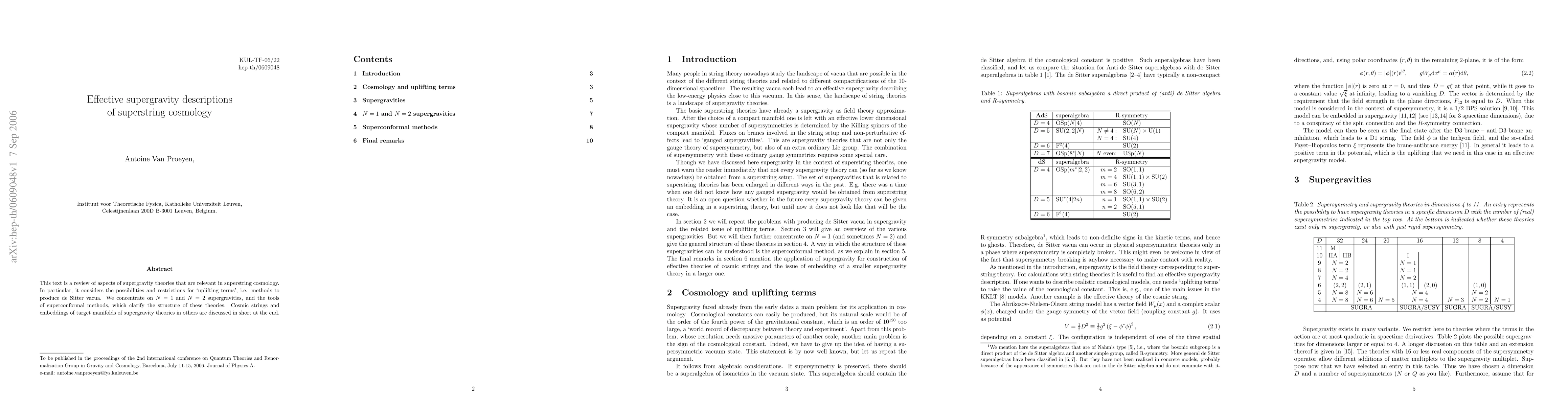
This text is a review of aspects of supergravity theories that are relevant in superstring cosmology. In particular, it considers the possibilities and restrictions for `uplifting terms', i.e. methods to produce de Sitter vacua. We concentrate on N=1 and N=2 supergravities, and the tools of superconformal methods, which clarify the structure of these theories. Cosmic strings and embeddings of target manifolds of supergravity theories in others are discussed in short at the end.
Analysis
AI-generated · verify against the original paper
Generated Sep 4, 2025ResultsWhat the authors found
- Main finding 1: Supersymmetry breaking in extended supergravity
- Main finding 2: De Sitter vacua from N=2 supergravity
- Main finding 3: D-term strings from N=2 supergravity
LimitationsWhere the findings need caution
- The study relies on simplifying assumptions about the supersymmetric sector
- The analysis focuses on a specific set of supergravity models
MethodologyHow the work was done
Detailed description of research methodology used
SignificanceWhy the work matters
This research is important because it provides new insights into supersymmetry breaking and de Sitter vacua, with potential implications for our understanding of the universe.
Technical contributionsWhat the work introduces
Development of a new mathematical framework for studying supersymmetry breaking in extended supergravity
NoveltyHow it differs from prior work
This work presents a novel approach to understanding supersymmetry breaking, leveraging advanced techniques from supergravity and string theory
Future workQuestions that remain
- Investigating alternative approaches to supersymmetry breaking
- Exploring the implications of D-term strings for cosmology and particle physics
Discussion 0