Embodied Intelligence for Spectrum Map Construction in Low-Altitude Wireless Networks
Abstract
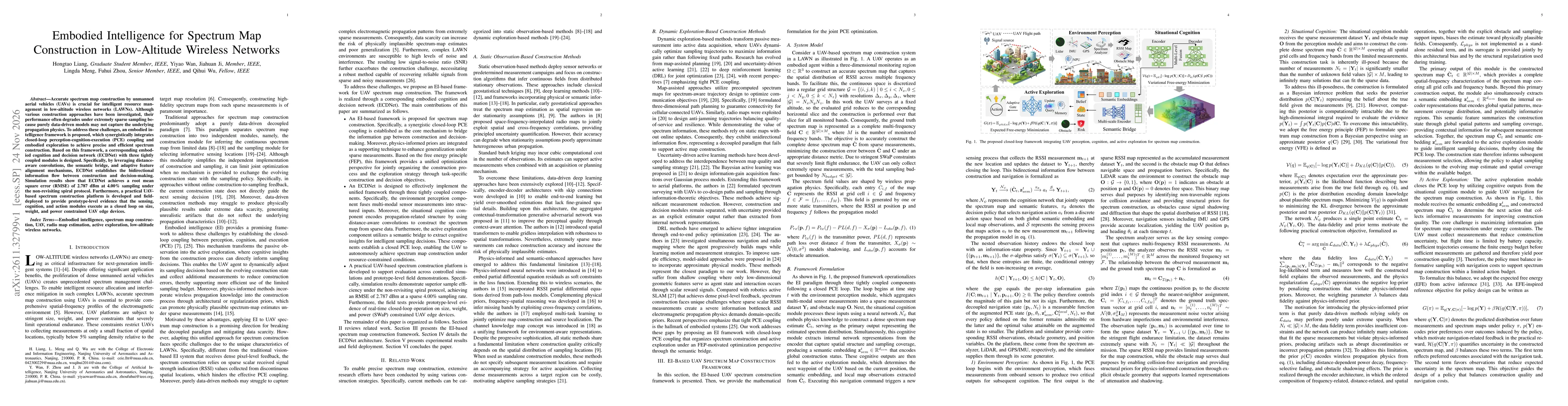
Accurate spectrum map construction by unmanned aerial vehicles (UAVs) is crucial for intelligent resource management in low-altitude wireless networks (LAWNs). Although various construction approaches have been investigated, their performance often degrades under extremely sparse sampling because purely data-driven models may not capture the underlying propagation physics. To address these challenges, an embodied intelligence framework is proposed, which synergistically integrates closed-loop perception-cognition-execution (PCE) coupling and embodied exploration to achieve precise and efficient spectrum construction. Based on this framework, a corresponding embodied cognition and decision network (ECDNet) with three tightly coupled modules is designed. Specifically, by leveraging distance-aware convolutions, the semantic bridge, and adaptive feature alignment mechanisms, ECDNet establishes the bidirectional information flow between construction and decision-making. Simulation results show that ECDNet achieves a root mean square error (RMSE) of 2.787 dBm at 4.00% sampling under the non-revisiting spiral protocol. Furthermore, a practical UAV-based spectrum construction platform is developed and field-deployed to provide prototype-level evidence that the sensing, cognition, and action modules execute as a closed loop on size, weight, and power constrained UAV edge devices.
AI Key Findings
Get AI-generated insights about this paper's methodology, results, significance, and more — available when analysis has been generated.
Discussion 0