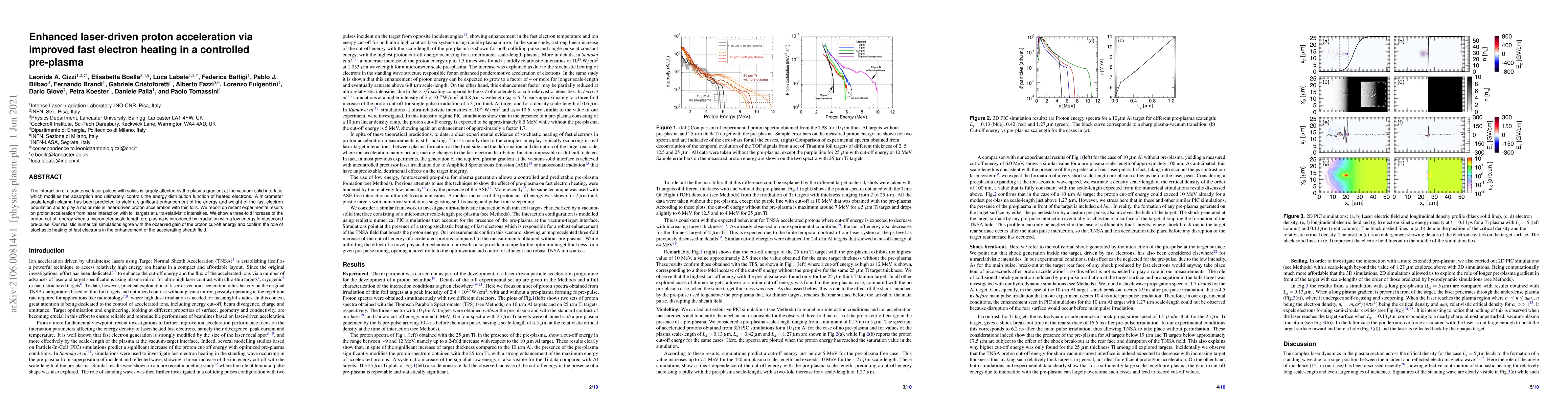
This paper reports on enhanced laser-driven proton acceleration achieved by introducing a micrometer scale-length pre-plasma, which increases the proton cut-off energy by three times. The study attributes this improvement to the stochastic heating of fast electrons in the pre-plasma, as confirmed by both experimental results and numerical simulations.
Abstract
The interaction of ultraintense laser pulses with solids is largely affected by the plasma gradient at the vacuum-solid interface, which modifies the absorption and ultimately, controls the energy distribution function of heated electrons. A micrometer scale-length plasma has been predicted to yield a significant enhancement of the energy and weight of the fast electron population and to play a major role in laser-driven proton acceleration with thin foils. We report on recent experimental results on proton acceleration from laser interaction with foil targets at ultra-relativistic intensities. We show a three-fold increase of the proton cut-off energy when a micrometer scale-length pre-plasma is introduced by irradiation with a low energy femtosecond pre-pulse. Our realistic numerical simulations agree with the observed gain of the proton cut-off energy and confirm the role of stochastic heating of fast electrons in the enhancement of the accelerating sheath field.
AI Key Findings
Get AI-generated insights about this paper's methodology, results, significance, and more — available when analysis has been generated.
Discussion 0