Enhancing Virtual Try-On with Synthetic Pairs and Error-Aware Noise Scheduling
This research addresses the challenges in virtual try-on by generating synthetic (human, garment) pairs to augment training data and introduces an Error-Aware Refinement-based Schr\"odinger Bridge (EARSB) to correct localized errors in the generated images, ultimately improving image quality and user preference.
Abstract
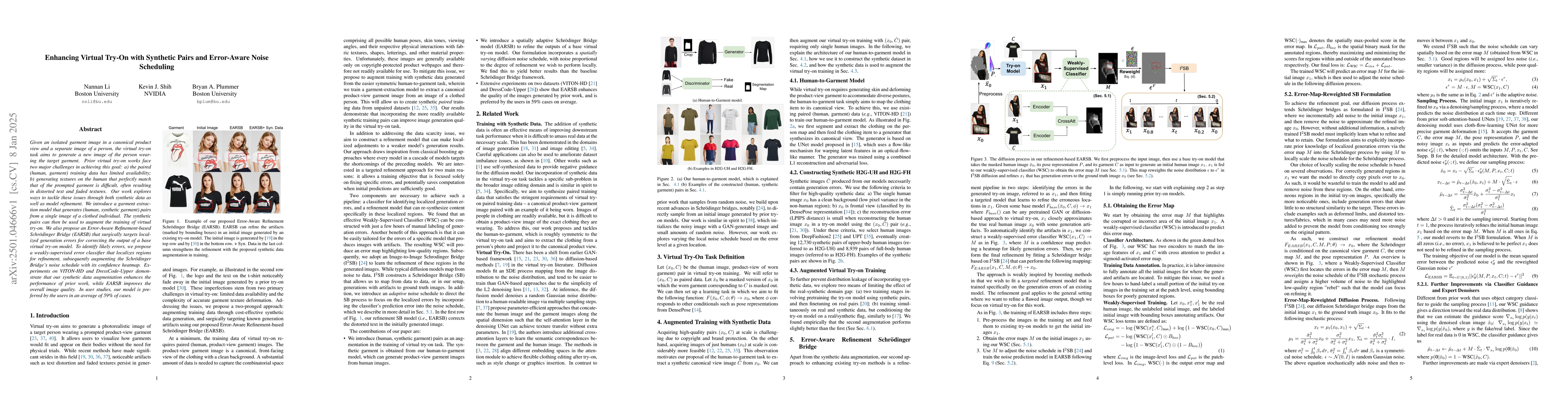
Given an isolated garment image in a canonical product view and a separate image of a person, the virtual try-on task aims to generate a new image of the person wearing the target garment. Prior virtual try-on works face two major challenges in achieving this goal: a) the paired (human, garment) training data has limited availability; b) generating textures on the human that perfectly match that of the prompted garment is difficult, often resulting in distorted text and faded textures. Our work explores ways to tackle these issues through both synthetic data as well as model refinement. We introduce a garment extraction model that generates (human, synthetic garment) pairs from a single image of a clothed individual. The synthetic pairs can then be used to augment the training of virtual try-on. We also propose an Error-Aware Refinement-based Schr\"odinger Bridge (EARSB) that surgically targets localized generation errors for correcting the output of a base virtual try-on model. To identify likely errors, we propose a weakly-supervised error classifier that localizes regions for refinement, subsequently augmenting the Schr\"odinger Bridge's noise schedule with its confidence heatmap. Experiments on VITON-HD and DressCode-Upper demonstrate that our synthetic data augmentation enhances the performance of prior work, while EARSB improves the overall image quality. In user studies, our model is preferred by the users in an average of 59% of cases.
AI Key Findings
Get AI-generated insights about this paper's methodology, results, significance, and more — available when analysis has been generated.
Discussion 0