Entanglement-Assisted Quantum Differential Privacy
Abstract
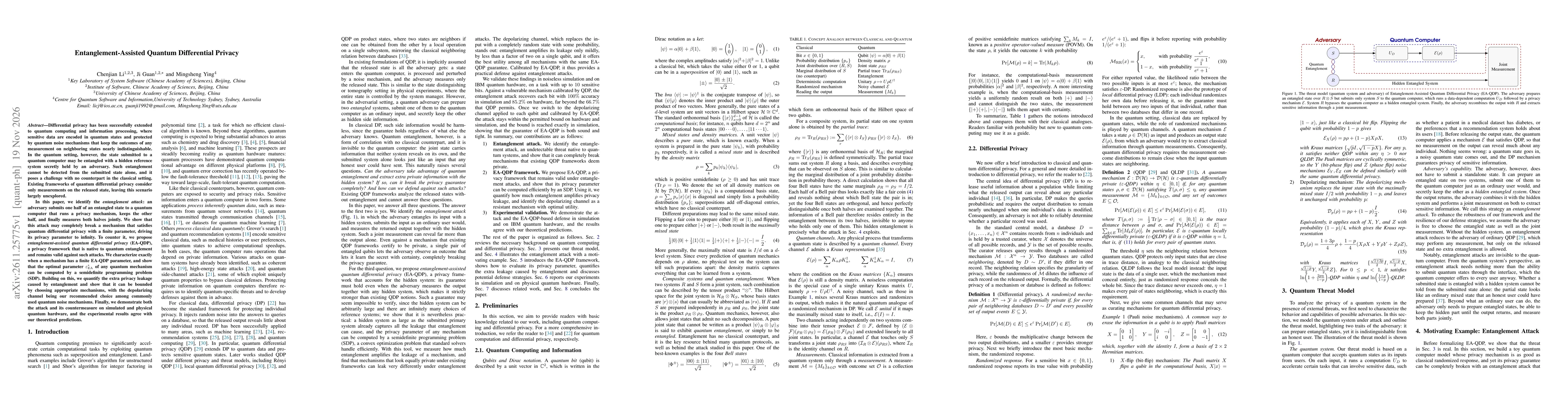
Differential privacy has been successfully extended to quantum computing and information processing, where sensitive data are encoded in quantum states and protected by quantum noise mechanisms that keep the outcomes of any measurement on neighboring states nearly indistinguishable. In the quantum setting, however, the state submitted to a quantum computer may be entangled with a hidden reference system secretly held by an adversary. Such entanglement cannot be detected from the submitted state alone, and it poses a challenge with no counterpart in the classical setting. Existing frameworks of quantum differential privacy consider only measurements on the released state, leaving this scenario largely unexplored. In this paper, we identify the entanglement attack: an adversary submits one half of an entangled state to a quantum computer that runs a privacy mechanism, keeps the other half, and finally measures both halves jointly. We show that this attack may completely break a mechanism that satisfies quantum differential privacy with a finite parameter, driving its privacy parameter to infinity. To counter it, we propose entanglement-assisted quantum differential privacy (EA-QDP), a privacy framework that is native to quantum entanglement and remains valid against such attacks. We characterize exactly when a mechanism has a finite EA-QDP parameter, and show that the optimal parameter $\varepsilon^*_{\mathrm{EA}}$ of any quantum mechanism can be computed by a semidefinite programming problem (SDP). Building on this, we quantify the extra privacy leakage caused by entanglement and show that it can be bounded by choosing appropriate mechanisms, with the depolarizing channel being our recommended choice. Finally, we demonstrate both the attack and its countermeasure on simulated and physical quantum hardware, and the experimental results agree with our theoretical predictions.
Analysis
AI-generated · verify against the original paper
Generated Jan 1, 0001ResultsWhat the authors found
- The entanglement attack can completely break any mechanism that satisfies standard QDP with a finite privacy parameter, driving its parameter to infinity.
- EA‑QDP provides a strictly stronger privacy guarantee that remains valid under entanglement attacks, and its optimal privacy parameter ε*EA can be computed efficiently via an SDP.
- Among common noise mechanisms, the depolarizing channel exhibits minimal entanglement‑amplified leakage and offers the best utility under the EA‑QDP guarantee.
- Experimental results on simulated data and up to 10‑qubit tasks on IBM hardware match the theoretical predictions, confirming both the vulnerability of standard QDP and the effectiveness of the EA‑QDP defense.
LimitationsWhere the findings need caution
- The analysis and experiments focus primarily on single‑qubit noise channels and tasks involving up to ten sensitive qubits.
- The recommended depolarizing channel is evaluated only within the class of commonly used quantum noise mechanisms.
MethodologyHow the work was done
The authors define the entanglement attack where an adversary submits half of an entangled state to a quantum mechanism and jointly measures with the hidden half. They introduce the Entanglement‑Assisted Quantum Differential Privacy (EA‑QDP) framework, characterize when a mechanism has a finite EA‑QDP parameter, and show that the optimal parameter can be obtained by solving a semidefinite program (SDP). They quantify extra leakage caused by entanglement, recommend the depolarizing channel as a robust mechanism, and validate the attack and defense on both noiseless simulations and IBM quantum hardware.
SignificanceWhy the work matters
This work reveals a fundamental vulnerability in existing quantum differential privacy schemes caused by entanglement, and establishes a new, provably secure privacy framework that is applicable to real quantum hardware, thereby advancing the security foundations of quantum data processing.
Technical contributionsWhat the work introduces
Introduction of the entanglement attack model, formulation of the Entanglement‑Assisted Quantum Differential Privacy framework, derivation of exact conditions for finite EA‑QDP parameters, and an SDP‑based method to compute the optimal privacy parameter, together with experimental validation on quantum hardware.
NoveltyHow it differs from prior work
First to identify and formally analyze entanglement‑based attacks on quantum differential privacy and to propose a native EA‑QDP framework that remains secure against such attacks.
Future workQuestions that remain
- Investigate EA‑QDP guarantees for larger quantum systems and more complex noise mechanisms.
- Develop tighter bounds on entanglement‑induced leakage and explore alternative mechanisms beyond depolarizing channels.
Discussion 0