Erasing the Wrong Thing: Conditional Attribute Leakage and Concept Erasure in Shared Foundation-Model Embeddings
Abstract
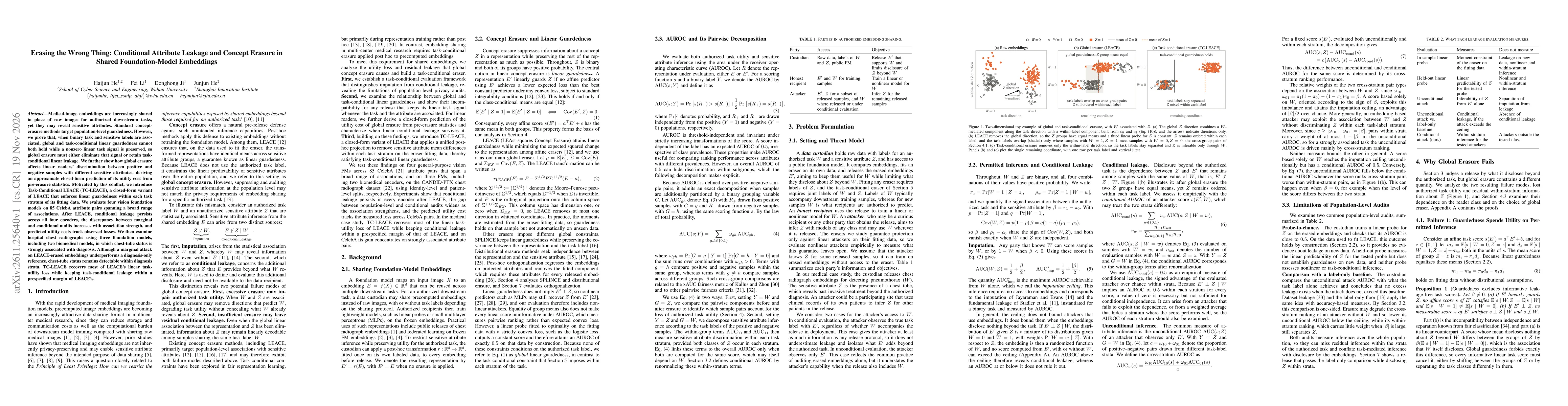
Medical-image embeddings are increasingly shared in place of raw images for authorized downstream tasks, yet they may reveal sensitive attributes. Standard concept-erasure methods target population-level guardedness. However, we prove that, when binary task and sensitive labels are associated, global and task-conditional linear guardedness cannot both hold while a nonzero linear task signal is preserved, so global erasure must either eliminate that signal or retain task-conditional linear leakage. We further show how global erasure affects linear readers' discrimination between positive and negative samples with different sensitive attributes, deriving an approximate closed-form prediction of its utility cost from pre-erasure statistics. Motivated by this conflict, we introduce Task-Conditional LEACE (TC-LEACE), a closed-form variant of LEACE that enforces linear guardedness within each task stratum of its fitting data. We evaluate four vision foundation models on 85 CelebA attribute pairs spanning a broad range of associations. After LEACE, conditional leakage persists across all four encoders, the discrepancy between marginal and conditional audits increases with association strength, and predicted utility costs track observed losses. We then examine hospital chest radiographs using three foundation models, including two biomedical models, in which chest-tube status is strongly associated with diagnosis. Although a marginal attack on LEACE-erased embeddings underperforms a diagnosis-only reference, chest-tube status remains detectable within diagnosis strata. TC-LEACE recovers most of LEACE's linear task-utility loss while keeping task-conditional leakage within a prespecified margin of LEACE's.
Analysis
AI-generated · verify against the original paper
Generated Jan 1, 0001ResultsWhat the authors found
- Conditional leakage persists after applying LEACE to all four encoders, and the gap between marginal and conditional audits widens with stronger task‑attribute association.
- The predicted utility cost from pre‑erasure statistics closely matches the observed loss in task performance across CelebA attribute pairs.
- TC‑LEACE recovers most of the linear task‑utility loss incurred by LEACE while keeping task‑conditional leakage within a prespecified margin of LEACE’s leakage.
- In the chest‑radiograph study, chest‑tube status remains detectable within diagnosis strata after LEACE, but TC‑LEACE reduces this conditional leakage and restores utility.
LimitationsWhere the findings need caution
- The analysis and experiments focus on linear readers and binary task/sensitive attributes, limiting conclusions for non‑linear attacks or multi‑class settings.
- Evaluations are confined to a specific set of vision foundation models and datasets (CelebA and CANDID‑PTX), so generalization to other modalities or larger model families remains untested.
MethodologyHow the work was done
We prove that global and task-conditional linear guardedness cannot coexist when binary task and sensitive labels are associated, derive a closed‑form prediction of utility cost for global erasure, and introduce Task‑Conditional LEACE (TC‑LEACE), a closed‑form post‑hoc projector that enforces linear guardedness within each task stratum. We evaluate TC‑LEACE and baseline LEACE on four vision foundation models across 85 CelebA attribute pairs and on three medical imaging foundation models using chest‑radiograph data.
SignificanceWhy the work matters
The work reveals a fundamental trade‑off between global concept erasure and task‑conditional privacy, demonstrating that population‑level guardedness alone is insufficient for protecting sensitive attributes without sacrificing utility, and provides a practical solution that balances privacy and downstream performance.
Technical contributionsWhat the work introduces
We provide a theoretical incompatibility proof for global vs. task‑conditional linear guardedness, a closed‑form utility‑cost estimator for global erasure, and the TC‑LEACE algorithm that enforces task‑conditional linear guardedness via a unified post‑hoc projection.
NoveltyHow it differs from prior work
First to identify and formally prove the conflict between global and task‑conditional linear guardedness for associated binary labels, and to propose a task‑conditional variant of LEACE that mitigates this conflict while preserving downstream utility.
Discussion 0