Evaluation of Complexity Measures for Deep Learning Generalization in Medical Image Analysis
This paper evaluates 25 complexity measures to understand their correlation with the generalization performance of deep learning models for breast ultrasound images. The study finds that PAC-Bayes flatness-based and path norm-based measures best explain model generalization, while multi-task learning approaches act as implicit regularizers, enhancing generalization.
Abstract
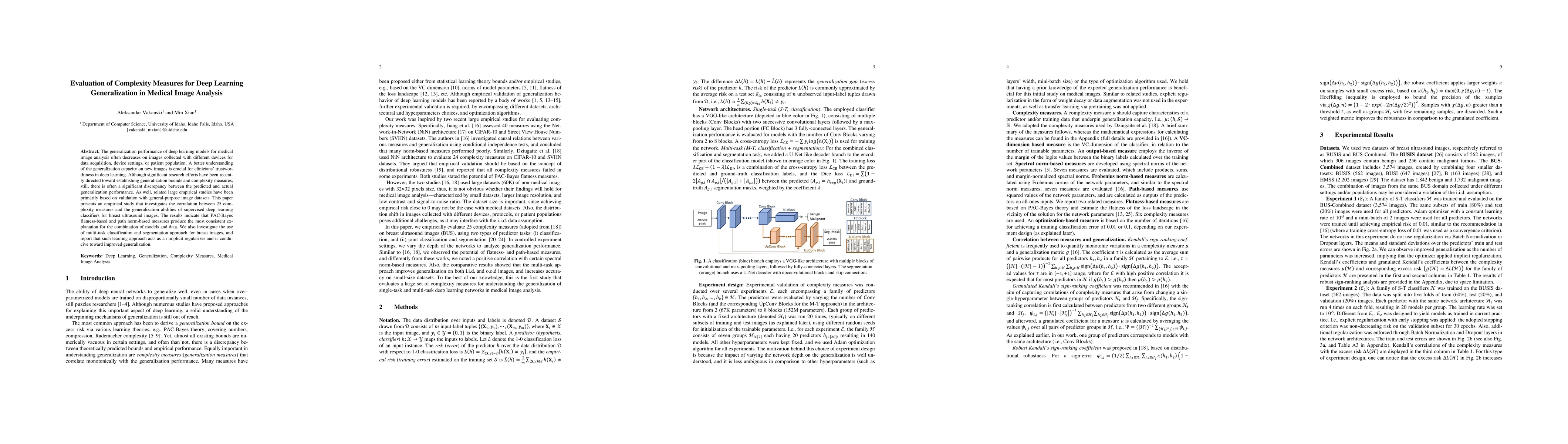
The generalization performance of deep learning models for medical image analysis often decreases on images collected with different devices for data acquisition, device settings, or patient population. A better understanding of the generalization capacity on new images is crucial for clinicians' trustworthiness in deep learning. Although significant research efforts have been recently directed toward establishing generalization bounds and complexity measures, still, there is often a significant discrepancy between the predicted and actual generalization performance. As well, related large empirical studies have been primarily based on validation with general-purpose image datasets. This paper presents an empirical study that investigates the correlation between 25 complexity measures and the generalization abilities of supervised deep learning classifiers for breast ultrasound images. The results indicate that PAC-Bayes flatness-based and path norm-based measures produce the most consistent explanation for the combination of models and data. We also investigate the use of multi-task classification and segmentation approach for breast images, and report that such learning approach acts as an implicit regularizer and is conducive toward improved generalization.
AI Key Findings
Get AI-generated insights about this paper's methodology, results, significance, and more — available when analysis has been generated.
Discussion 0