Event ActivityNet: A Large-Scale Simulated-Event Benchmark for Untrimmed Action Understanding
Abstract
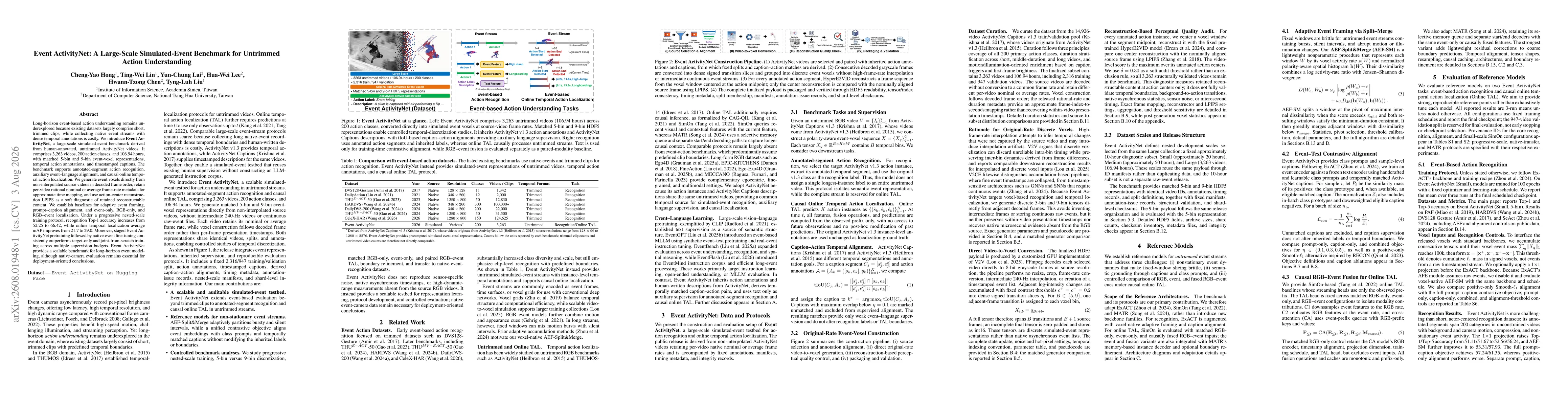
Long-horizon event-based action understanding remains underexplored because existing datasets largely comprise short, trimmed clips, while collecting native event streams with dense temporal annotations is costly. We introduce Event ActivityNet, a large-scale simulated-event benchmark derived from human-annotated, untrimmed ActivityNet videos. It comprises 3,263 videos, 200 action classes, and 106.94 hours, with matched 5-bin and 9-bin event-voxel representations, temporal action annotations, and timestamped captions. The benchmark supports annotated-segment action recognition, auxiliary event-language alignment, and causal online temporal action localization. We generate event voxels directly from non-interpolated source videos in decoded frame order, retain per-video rational nominal or average frame-rate metadata for approximate time mapping, and use action-center reconstruction LPIPS as a soft diagnostic of retained reconstructable content. We establish baselines for adaptive event framing, prompt-caption alignment, and event-only, RGB-only, and RGB-event localization. Under a progressive nested-scale training protocol, recognition Top-1 accuracy increases from 52.25 to 66.42, while online temporal localization average mAP improves from 21.7 to 29.0. Moreover, staged Event ActivityNet pretraining followed by native-event fine-tuning consistently outperforms target-only and joint-from-scratch training across multiple supervision budgets. Event ActivityNet provides a scalable benchmark for long-horizon event modeling, although native-camera evaluation remains essential for deployment-oriented conclusions.
Analysis
AI-generated · verify against the original paper
Generated Aug 5, 2026ResultsWhat the authors found
- Under progressive nested-scale training, recognition Top-1 accuracy improves from 52.25 to 66.42 and online TAL average mAP from 21.7 to 29.0.
- Staged Event ActivityNet pretraining followed by native-event fine-tuning consistently outperforms target-only and joint-from-scratch training across multiple supervision budgets.
- Matched 5-bin and 9-bin representations enable controlled analyses of temporal discretization effects on recognition and localization.
- Baseline methods including AEF-Split&Merge and RGB–event fusion provide competitive reference points for non-stationary event streams.
LimitationsWhere the findings need caution
- Native-camera evaluation remains essential for deployment-oriented conclusions, indicating a gap between simulated-event benchmarks and real-sensor performance.
- The benchmark does not reproduce sensor-specific noise, asynchronous timestamps, or high-dynamic-range measurements present in source RGB videos.
- Temporal discretization choices (5-bin vs 9-bin) may influence results, potentially limiting direct comparability across studies using different discretizations.
MethodologyHow the work was done
The paper presents Event ActivityNet, a large-scale simulated-event benchmark derived from ActivityNet videos, providing matched 5-bin and 9-bin event-voxel representations, temporal action annotations, and timestamped captions to enable annotated-segment action recognition, auxiliary event-language alignment, and causal online temporal action localization. It uses decoded frame order voxel construction, retains video-level frame-rate metadata for approximate timing, and employs action-center reconstruction LPIPS as a soft diagnostic. Baselines include adaptive event framing (AEF-Split&Merge), prompt-caption alignment, and evaluations for event-only, RGB-only, and RGB-event localization, all under a progressive nested-scale training protocol that improves recognition and online TAL metrics. The dataset splits, annotations, and integrated supervision enable controlled ablation studies, including discretization variations (5-bin vs 9-bin) and staged pretraining strategies that consistently outperform target-only or joint-from-scratch training across supervision budgets.
SignificanceWhy the work matters
Event ActivityNet provides a scalable, controlled simulated-event benchmark for long-horizon event modeling in untrimmed streams, enabling robust evaluation of event representations, language alignment, and online localization while preserving inherited ActivityNet supervision for reproducibility and comparability.
Technical contributionsWhat the work introduces
A scalable simulated-event benchmark (Event ActivityNet) with matched 5-bin/9-bin event-voxel representations, temporal action annotations, and timestamped captions, plus baseline models (AEF-Split&Merge, prompt-caption alignment, RGB-only/RGB–event TAL) and a progressive nested-scale training protocol that yields improved recognition and online localization performance.
NoveltyHow it differs from prior work
First large-scale, untrimmed simulated-event benchmark derived from ActivityNet that enables annotated-segment recognition and causal online TAL with explicit event-voxel representations, providing controlled evaluation of discretization, representation learning, and cross-modal alignment without modifying inherited labels or boundaries.
Future workQuestions that remain
- Develop methods to bridge simulated-event representations with native camera data for more deployment-ready evaluations.
- Explore more fine-grained temporal discretizations and adaptive binning strategies to better capture long-horizon dynamics.
- Extend benchmarks to include additional supervision signals (e.g., richer captions, action relations) and richer evaluation metrics for online decision-making.
- Investigate improved contrastive alignment techniques that integrate cross-modal prompts and temporally aligned captions without modifying labels.
Discussion 0