Evidence-Carrying Transport Across Effects
Abstract
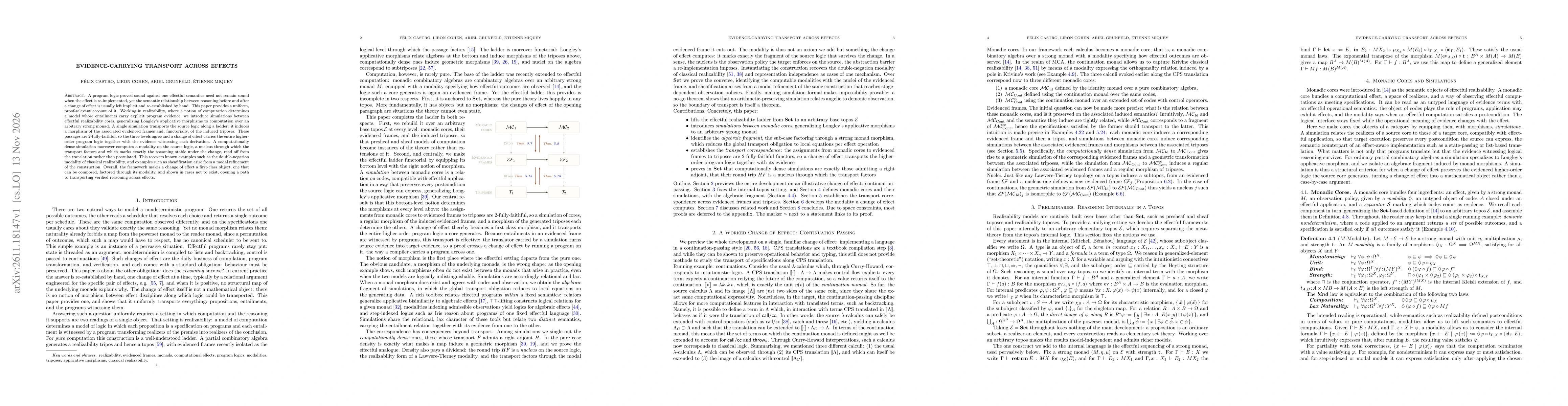
A program logic proved sound against one effectful semantics need not remain sound when the effect is re-implemented, yet the semantic relationship between reasoning before and after a change of effect is usually left implicit and re-established by hand. This paper provides a uniform, proof-relevant account of it. Working in realizability, where a notion of computation determines a model whose entailments carry explicit program evidence, we introduce simulations between effectful realizability cores, generalizing Longley's applicative morphisms to computation over an arbitrary strong monad. A single simulation transports the source logic along a ladder: it induces a morphism of the associated evidenced frames and, functorially, of the induced triposes. These passages are $2$-fully-faithful, so the three levels agree and a change of effect carries the entire higher-order program logic together with the evidence witnessing each derivation. A computationally dense simulation moreover computes a modality on the source logic, a nucleus through which the transport factors and which marks exactly the reasoning stable under the change, read off from the translation rather than postulated. This recovers known examples such as the double-negation modality of classical realizability, and examples such as sheafification arise from a modal refinement of the construction. Overall, the framework makes a change of effect a first-class object, one that can be composed, factored through its modality, and shown in cases not to exist, opening a path to transporting verified reasoning across effects.
Analysis
AI-generated · verify against the original paper
Generated Jan 1, 0001ResultsWhat the authors found
- A single simulation transports the entire higher-order program logic across effects, inducing morphisms of evidenced frames and triposes that are 2‑fully‑faithful.
- Computationally dense simulations compute a modality (a nucleus) on the source logic, factoring the transport and characterising reasoning stable under the effect change.
- The framework recovers known examples such as the double‑negation modality of classical realizability and yields new examples like sheafification via modal refinement.
LimitationsWhere the findings need caution
- The initial effectful ladder was anchored to Set and lacked morphisms, limiting its applicability to more general toposes.
- Simulations are relational and lax, and suitable monad morphisms often do not exist, restricting when the transport can be realized.
MethodologyHow the work was done
The paper works in realizability, building monadic cores over an arbitrary base topos and defining simulations between these effectful realizability cores. It uses categorical constructions to lift simulations to morphisms of evidenced frames and triposes, and studies computationally dense simulations to derive modalities.
SignificanceWhy the work matters
The work provides a uniform, proof‑relevant account of how program logics can be transported across different computational effects, making the change of effect a first‑class, composable object and enabling verified reasoning to be preserved under effect transformations.
Technical contributionsWhat the work introduces
Definition of simulations between monadic cores that generalise Longley’s applicative morphisms, proof that these simulations induce 2‑fully‑faithful morphisms of evidenced frames and triposes, and the identification of computationally dense simulations as sources of logical modalities.
NoveltyHow it differs from prior work
Introducing change of effect as a first‑class morphism that can be composed, factored through a modality, and analyzed categorically, thereby unifying and extending previous ad‑hoc approaches to transporting program logic across effects.
Discussion 0