Evolve to Learn: Gradient-aligned experience evolution for model self-improvement
Abstract
Self-evolving language models can continuously acquire useful experience through test-time interaction, reflection, and prompt optimization, yet turning such experience into model itself to ensure self improvement remains challenging. On-policy self-distillation (OPSD) provides a natural mechanism for internalizing test-time information into model parameters, yet it largely assumes that the gener- ated experience is worth learning. We show that this assumption does not always hold: experiences that improve test-time performance may provide limited or even harmful training signals. To better characterize which experience should be inter- nalized, we systematically analyze diverse mutated experiences across multiple tasks and reflection models, and find that gradient-based alignment is a more reli- able indicator of downstream distillation gains than immediate test-time improve- ment. Based on this finding, we propose E2L, a self-evolution framework that iteratively generates, evaluates, and distills experiences according to their esti- mated training utility. E2L closes the loop between experience generation and parameter learning, enabling agents to autonomously produce experience suitable for self-improvement.
Analysis
AI-generated · verify against the original paper
Generated Jan 1, 0001ResultsWhat the authors found
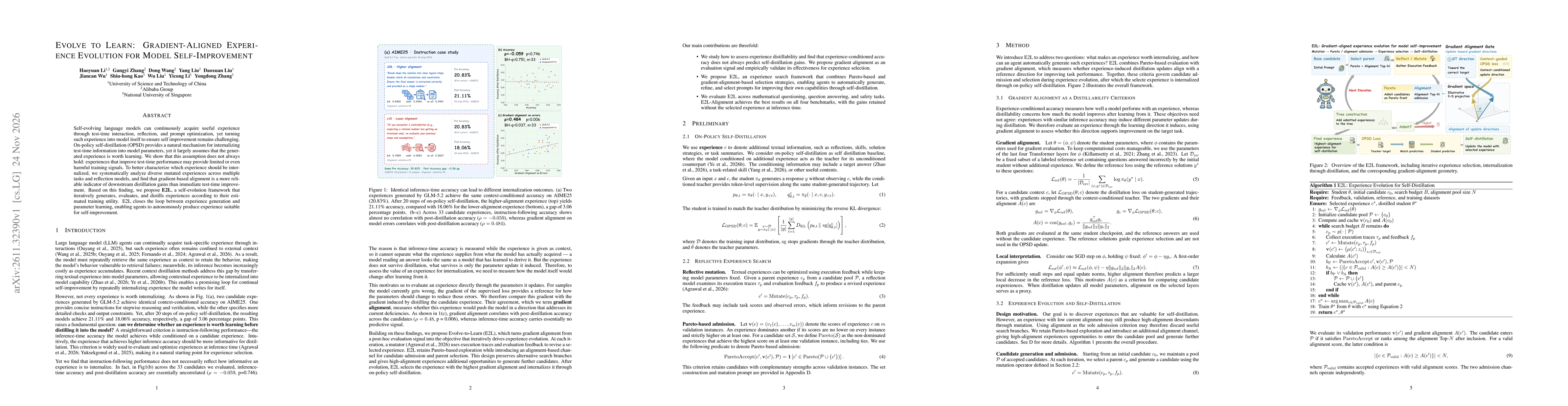
- Gradient alignment correlates with post‑distillation accuracy (ρ=0.48, p=0.006), while inference‑time accuracy shows no correlation (ρ=−0.059, p=0.746).
- Two experiences with identical inference accuracy (20.83%) yielded different distillation outcomes: the higher‑alignment experience achieved 21.11% accuracy versus 18.06% for the lower‑alignment one, a 3.06‑point gap.
MethodologyHow the work was done
E2L iteratively generates candidate experiences, evaluates them using gradient alignment between the supervised loss gradient and the distillation gradient, admits candidates via a Pareto‑based and alignment‑based admission gate, and internalizes the selected experience through on‑policy self‑distillation.
SignificanceWhy the work matters
E2L closes the loop between experience generation and parameter learning, allowing language model agents to autonomously produce and internalize experiences that reliably improve downstream performance.
Technical contributionsWhat the work introduces
Introduces a self‑evolution framework that uses gradient‑based alignment as a training‑utility estimator to guide experience mutation, selection, and internalization via on‑policy self‑distillation.
NoveltyHow it differs from prior work
First to employ gradient‑aligned experience evaluation as a criterion for selecting test‑time generated experiences for model self‑improvement, moving beyond traditional inference‑time accuracy metrics.
Discussion 0