Extremal Graphs for the Energy-Independence Number Inequality
Abstract
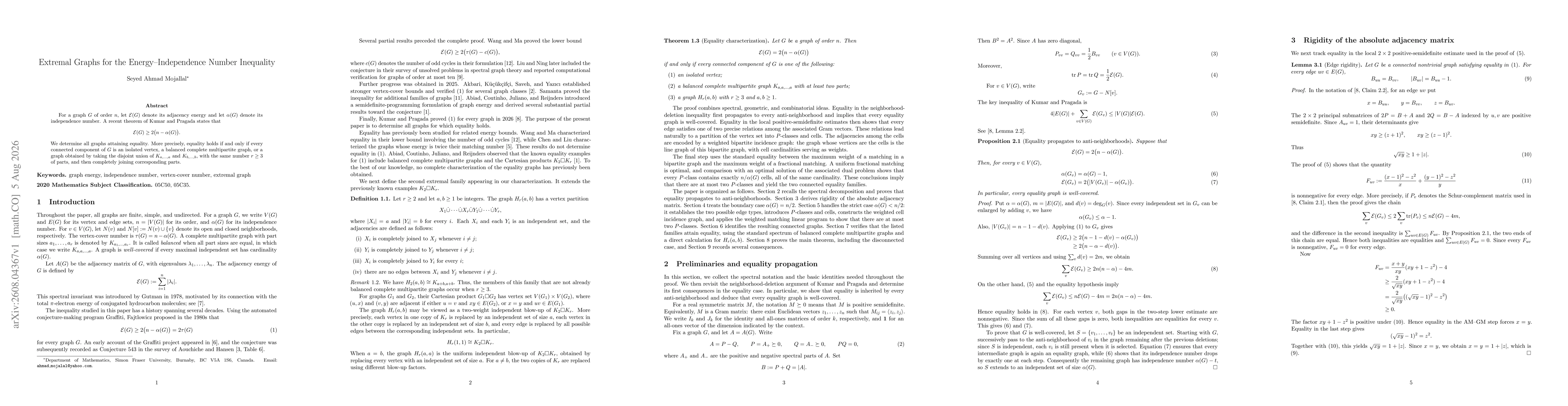
For a graph $G$ of order $n$, let $\mathcal E(G)$ denote its adjacency energy and let $α(G)$ denote its independence number. A recent theorem of Kumar and Pragada states that $$\mathcal E(G)\ge 2\bigl(n-α(G)\bigr).$$ We determine all graphs attaining equality. More precisely, equality holds if and only if every connected component of $G$ is an isolated vertex, a balanced complete multipartite graph, or a graph obtained by taking the disjoint union of $K_{a,\ldots,a}$ and $K_{b,\ldots,b}$, with the same number $r\ge3$ of parts, and then completely joining corresponding parts.
Analysis
AI-generated · verify against the original paper
Generated Aug 7, 2026ResultsWhat the authors found
- Equality E(G) = 2(n − α(G)) holds if and only if every connected component of G belongs to one of the identified families.
- Identified families include isolated vertices, balanced complete multipartite graphs, and graphs obtained from disjoint unions of Hr(a,b) with the same number of parts r≥3, then fully joining corresponding parts.
- Hr(a,b) generalizes known examples like K2 □ Kr and allows a,b with a ≠ b to produce equal-energy graphs under the stated construction.
LimitationsWhere the findings need caution
- Focus is on equality cases for the specific inequality; the approach may not directly extend to near-equality or to related energy bounds without substantial adaptation.
- Results rely on component-wise decomposition; interactions between components are not present, which may limit applicability to non-standard graph compositions.
- The Hr(a,b) family, while broad, may require case-by-case verification for certain parameter choices not explicitly enumerated.
MethodologyHow the work was done
The authors characterize all graphs achieving equality in the energy–independence number inequality by structural analysis of connected components and leveraging known graph energy bounds. They show that equality occurs precisely for components that are isolated vertices, balanced complete multipartite graphs, or Hr(a,b) constructions with identical r≥3 parts, followed by joining corresponding parts across components.
SignificanceWhy the work matters
Provides a complete extremal classification for the energy–independence number inequality, resolving which graphs attain the lower bound and clarifying the structure of extremal graphs in spectral graph theory.
Technical contributionsWhat the work introduces
A complete characterization of extremal graphs attaining equality in the energy–independence number inequality, detailing precise graph families (isolated vertices, balanced complete multipartite graphs, and specific Hr(a,b) constructions) and proving necessity and sufficiency via component-wise analysis.
NoveltyHow it differs from prior work
First full resolution of equality graphs for E(G) ≥ 2(n − α(G)), introducing Hr(a,b) as a unifying construction and establishing that equality constrains every connected component to belong to the identified families.
Future workQuestions that remain
- Extend the framework to characterize near-equality cases and quantify stability: graphs with energy close to the bound.
- Explore analogous complete classifications for related energy bounds involving other graph invariants.
- Investigate algorithmic recognition of extremal structures in large graphs and potential generalizations to weighted or directed graphs.
Discussion 0