FabricBench: A Standardized Policy Benchmark for Bimanual Fabric Manipulation with a Contact-Driven Deformable Simulator
Abstract
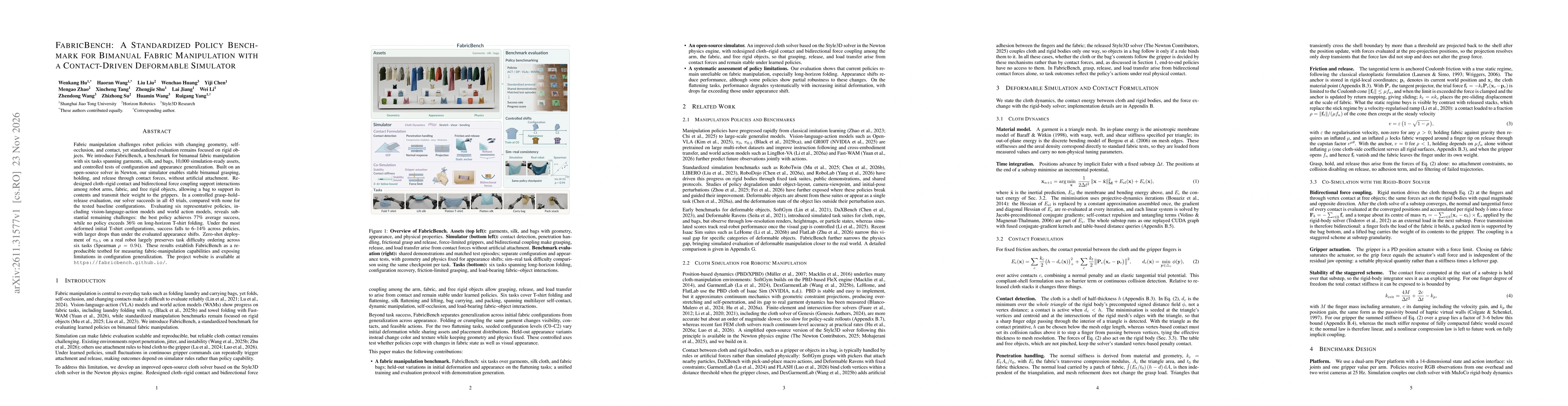
Fabric manipulation challenges robot policies with changing geometry, self-occlusion, and contact, yet standardized evaluation remains focused on rigid objects. We introduce FabricBench, a benchmark for bimanual fabric manipulation with six tasks spanning garments, silk, and bags, 10,000 simulation-ready assets, and controlled tests of configuration and appearance generalization. Built on an open-source solver in Newton, our simulator enables stable bimanual grasping, holding, and release through contact forces, without artificial attachment. Redesigned cloth-rigid contact and bidirectional force coupling support interactions among robot arms, fabric, and free rigid objects, allowing a bag to support its contents and transmit their weight to the grippers. In a controlled grasp-hold-release evaluation, our solver succeeds in all 45 trials, compared with none for the tested baseline configurations. Evaluating six representative policies, including vision-language-action models and world action models, reveals substantial remaining challenges: the best policy achieves 77% average success, while no policy exceeds 36% on long-horizon T-shirt folding. Under the most deformed initial T-shirt configurations, success falls to 6-14% across policies, with larger drops than under the evaluated appearance shifts. Zero-shot deployment of $π_{0.5}$ on a real robot largely preserves task difficulty ordering across six tasks (Spearman $ρ=0.94$). These results establish FabricBench as a reproducible testbed for measuring fabric-manipulation capabilities and exposing limitations in configuration generalization. The project website is available at https://fabricbench.github.io/.
AI Key Findings
Get AI-generated insights about this paper's methodology, results, significance, and more — available when analysis has been generated.
Discussion 0