FADRA: Frequency-Aware Diffusion with Residual Adaptation for Video Face Restoration
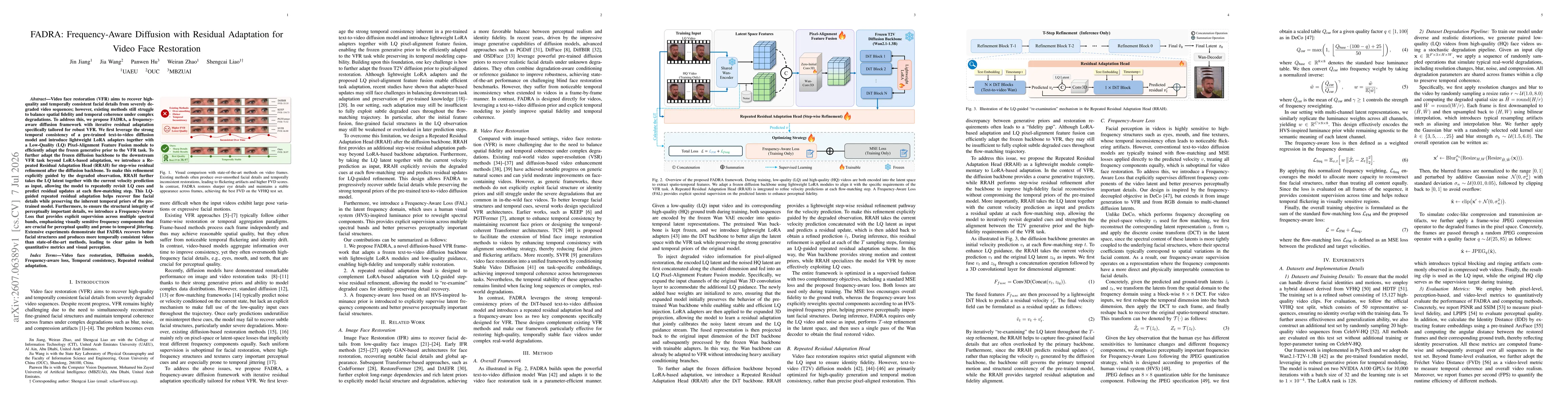
FADRA introduces a frequency-aware diffusion approach with iterative residual adaptation to improve video face restoration, leveraging a frozen text-to-video diffusion backbone, lightweight LoRA adapters, and a low-quality pixel-alignment fusion to adapt efficiently. A Repeated Residual Adaptation Head guided by degraded video frames refines details step-by-step, and a Frequency-Aware Loss boosts perceptual quality across spectral bands, yielding sharper, more temporally stable faces than previous methods.
Abstract
Video face restoration (VFR) aims to recover high-quality and temporally consistent facial details from severely degraded video sequences; however, existing methods still struggle to balance spatial fidelity and temporal coherence under complex degradations. To address this, we propose FADRA, a frequency-aware diffusion framework with iterative residual adaptation specifically tailored for robust VFR. We first leverage the strong temporal consistency of a pre-trained text-to-video diffusion model and introduce lightweight LoRA adapters together with a Low-Quality (LQ) Pixel-Alignment Feature Fusion module to efficiently adapt the frozen generative prior to the VFR task. To further adapt the frozen diffusion backbone to the downstream VFR task beyond LoRA-based adaptation, we introduce a Repeated Residual Adaptation Head (RRAH) for step-wise residual refinement after the diffusion backbone. To make this refinement explicitly guided by the degraded observation, RRAH further takes the LQ latent together with the current velocity prediction as input, allowing the model to repeatedly revisit LQ cues and predict residual updates at each flow-matching step. This LQ-guided repeated residual adaptation helps recover fine facial details while preserving the inherent temporal priors of the pre-trained model. Furthermore, to ensure the structural integrity of perceptually important details, we introduce a Frequency-Aware Loss that provides explicit supervision across multiple spectral bands, emphasizing visually sensitive frequency components that are crucial for perceptual quality and prone to temporal jittering. Extensive experiments demonstrate that FADRA recovers better facial structures and produces more temporally consistent videos than state-of-the-art methods, leading to clear gains in both quantitative metrics and visual perception.
Analysis
AI-generated · verify against the original paper
Generated Jul 9, 2026ResultsWhat the authors found
- FADRA achieves superior facial structural recovery and temporal stability, outperforming state-of-the-art VFR methods on both quantitative metrics and perceptual quality.
- RRAH enables effective further refinement beyond LoRA-based backbone adaptation, yielding notable improvements in identity preservation and flicker reduction without introducing substantial latency.
- Frequency-Aware Loss enhances preservation of high-frequency facial details and reduces temporal artifacts across frames.
LimitationsWhere the findings need caution
- Reliance on a pre-trained text-to-video diffusion model may limit adaptability to degradations not well represented in the pretraining domain.
- The additional RRAH module introduces a small computational overhead which, while modest, may impact deployment on very low-resource devices.
- Performance under extreme pose variations or highly dynamic degradations outside the training distribution remains to be thoroughly evaluated.
MethodologyHow the work was done
FADRA combines a frozen text-to-video diffusion backbone with lightweight LoRA adapters and a Low-Quality Pixel-Alignment Feature Fusion module for task adaptation, followed by a Repeated Residual Adaptation Head (RRAH) that refines velocity predictions in a LQ-guided, step-wise residual manner. A Frequency-Aware Loss (FAL) in the latent frequency domain provides supervision across spectral bands to preserve perceptually important details and reduce temporal jitter.
SignificanceWhy the work matters
The approach demonstrates that integrating a frozen diffusion prior with task-specific, lightweight adaptations and explicit frequency-aware supervision can jointly improve spatial fidelity and temporal coherence in video face restoration under severe degradations, pushing forward practical high-quality VFR performance.
Technical contributionsWhat the work introduces
Introduction of Repeated Residual Adaptation Head (RRAH) with LQ-guided, flow-matching residual refinement, a Low-Quality Pixel-Alignment Feature Fusion module, and a Frequency-Aware Loss to supervise latent spectral components within a frozen diffusion backbone for video face restoration.
NoveltyHow it differs from prior work
First to fuse a frozen text-to-video diffusion prior with lightweight task adapters and a residual refinement head guided by degraded observations, complemented by a spectral-domain loss to explicitly preserve perceptually important details and temporal consistency in VFR.
Future workQuestions that remain
- Explore more efficient backbone adaptations to further reduce latency while maintaining quality for real-time VFR.
- Investigation of robustness to extreme poses and diverse real-world degradations, including unseen compression artifacts.
- Extend the frequency-aware supervision to spatial-temporal frequency bands and explore adaptive weighting based on content complexity.
Discussion 0