Faithful Persona-based Conversational Dataset Generation with Large Language Models
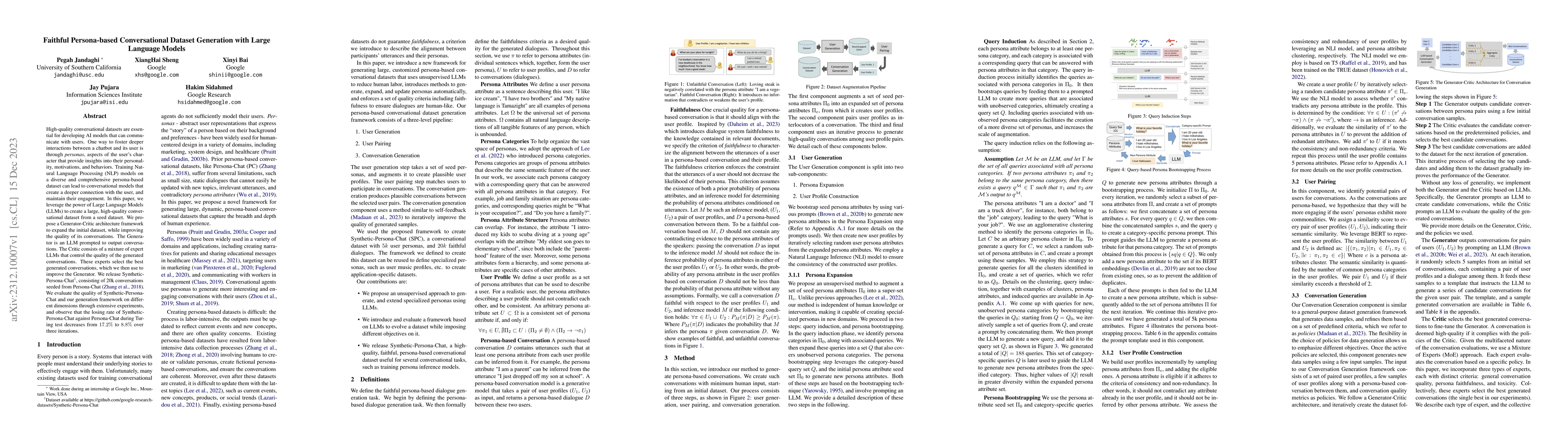
This paper proposes a Generator-Critic framework using Large Language Models to create a high-quality conversational dataset through persona-based interactions. The framework enhances the initial dataset, leading to improved conversational models that better engage users, as evidenced by a significant reduction in losing rate during Turing tests.
Abstract
High-quality conversational datasets are essential for developing AI models that can communicate with users. One way to foster deeper interactions between a chatbot and its user is through personas, aspects of the user's character that provide insights into their personality, motivations, and behaviors. Training Natural Language Processing (NLP) models on a diverse and comprehensive persona-based dataset can lead to conversational models that create a deeper connection with the user, and maintain their engagement. In this paper, we leverage the power of Large Language Models (LLMs) to create a large, high-quality conversational dataset from a seed dataset. We propose a Generator-Critic architecture framework to expand the initial dataset, while improving the quality of its conversations. The Generator is an LLM prompted to output conversations. The Critic consists of a mixture of expert LLMs that control the quality of the generated conversations. These experts select the best generated conversations, which we then use to improve the Generator. We release Synthetic-Persona-Chat, consisting of 20k conversations seeded from Persona-Chat. We evaluate the quality of Synthetic-Persona-Chat and our generation framework on different dimensions through extensive experiments, and observe that the losing rate of Synthetic-Persona-Chat against Persona-Chat during Turing test decreases from 17.2% to 8.8% over three iterations.
AI Key Findings
Get AI-generated insights about this paper's methodology, results, significance, and more — available when analysis has been generated.
Discussion 0