Fast and Strong Image Protection against Diffusion Personalization
Abstract
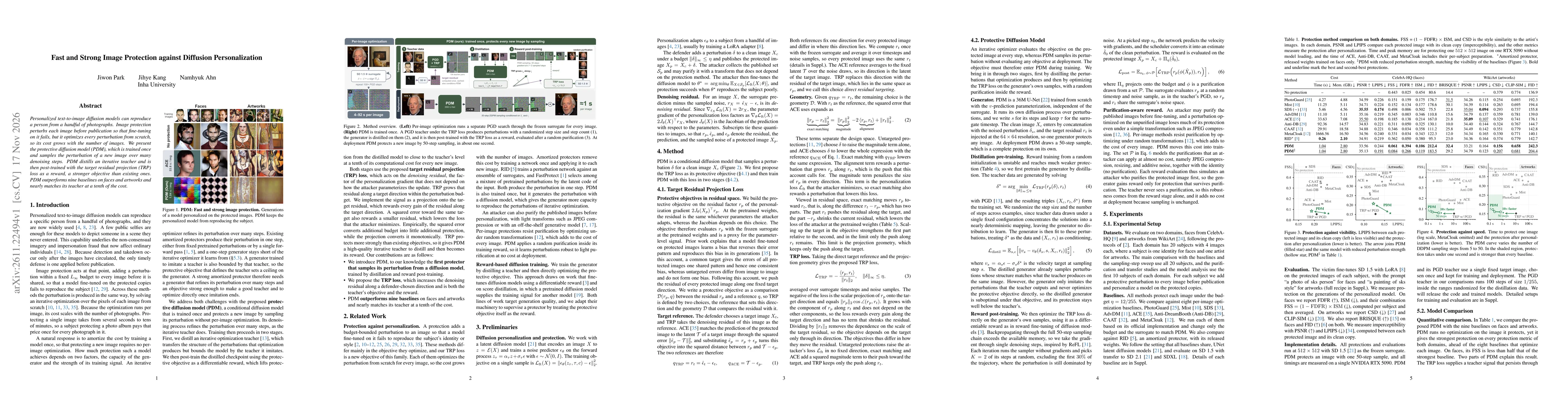
Personalized text-to-image diffusion models can reproduce a person from a handful of photographs. Image protection perturbs each image before publication so that fine-tuning on it fails, but it optimizes every perturbation from scratch, so its cost grows with the number of images. We present the protective diffusion model (PDM), which is trained once and samples the perturbation of a new image over many denoising steps. PDM distills an iterative teacher and is then post-trained with the target residual projection (TRP) loss as a reward, a stronger objective than existing ones. PDM outperforms nine baselines on faces and artworks and nearly matches its teacher at a tenth of the cost.
Analysis
AI-generated · verify against the original paper
Generated Jan 1, 0001ResultsWhat the authors found
- PDM outperforms nine baseline protection methods on both face and artwork datasets.
- PDM nearly matches the protective strength of its iterative teacher while using only one‑tenth of the computational cost.
- Sampling a perturbation for a new image takes about one second (≈50 DDPM steps) on a single RTX 5090.
MethodologyHow the work was done
PDM is trained in two stages: first, an iterative optimization teacher is distilled into a conditional diffusion model; second, the distilled model is post‑trained using the Target Residual Projection (TRP) loss as a differentiable reward, with random purification applied during training. At deployment, PDM protects a new image by sampling its perturbation over many denoising steps (≈50 steps) without per‑image optimization.
SignificanceWhy the work matters
The work provides the first amortized image‑protection method that leverages a diffusion model, dramatically lowering per‑image protection cost and enabling strong defense against diffusion personalization attacks at scale.
Technical contributionsWhat the work introduces
Introduces the Protective Diffusion Model (PDM) with a two‑stage training pipeline and the novel TRP loss that serves both as the teacher’s objective and as a reward for post‑training, enabling efficient, strong image protection.
NoveltyHow it differs from prior work
PDM is the first protector that samples perturbations from a diffusion model trained once, and the TRP loss is a new objective that directly projects the denoising residual onto a defender‑chosen direction.
Discussion 0