Fast likelihood evaluation for multivariate sensory discrimination models
Abstract
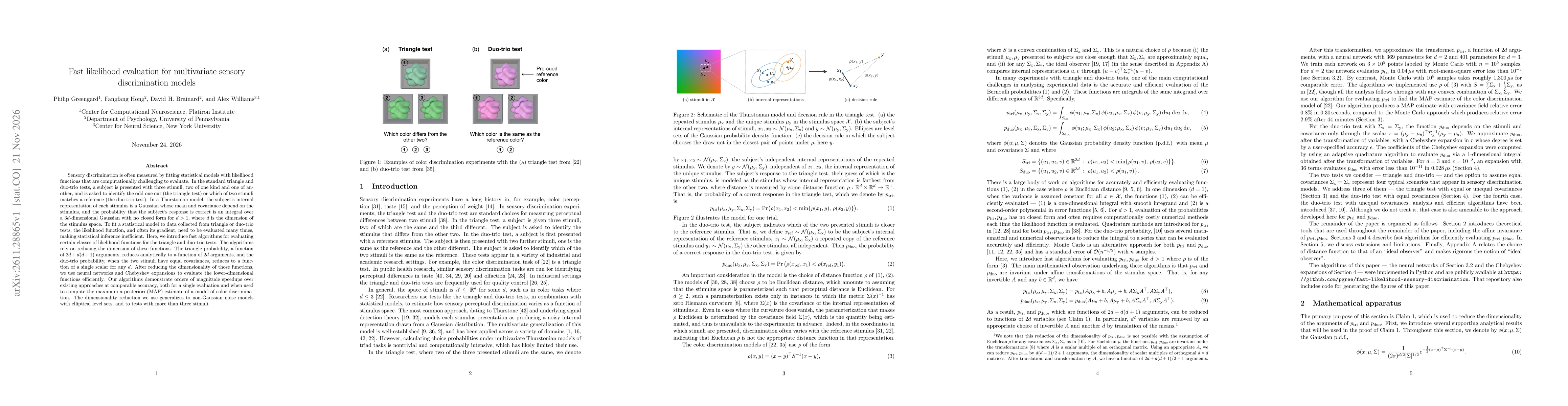
Sensory discrimination is often measured by fitting statistical models with likelihood functions that are computationally challenging to evaluate. In the standard triangle and duo-trio tests, a subject is presented with three stimuli, two of one kind and one of another, and is asked to identify the odd one out (the triangle test) or which of two stimuli matches a reference (the duo-trio test). In a Thurstonian model, the subject's internal representation of each stimulus is a Gaussian whose mean and covariance depend on the stimulus, and the probability that the subject's response is correct is an integral over a $3d$-dimensional Gaussian with no closed form for $d > 1$, where $d$ is the dimension of the stimulus space. To fit a statistical model to data collected from triangle or duo-trio tests, the likelihood function, and often its gradient, need to be evaluated many times, making statistical inference inefficient. Here, we introduce fast algorithms for evaluating certain classes of likelihood functions for the triangle and duo-trio tests. The algorithms rely on reducing the dimension of these functions. The triangle probability, a function of $2d + d(d+1)$ arguments, reduces analytically to a function of $2d$ arguments, and the duo-trio probability, when the two stimuli have equal covariances, reduces to a function of a single scalar for any $d$. After reducing the dimensionality of those functions, we use neural networks and Chebyshev expansions to evaluate the lower-dimensional functions efficiently. Our algorithms demonstrate orders of magnitude speedups over existing approaches at comparable accuracy, both for a single evaluation and when used to compute the maximum a posteriori (MAP) estimate of a model of color discrimination. The dimensionality reduction we use generalizes to non-Gaussian noise models with elliptical level sets, and to tests with more than three stimuli.
AI Key Findings
Get AI-generated insights about this paper's methodology, results, significance, and more — available when analysis has been generated.
Discussion 0