Faster than square-root run-time in adiabatic quantum algorithms for Exact Cover 3
Abstract
By intertwining ideas from sequential and adiabatic quantum computing, we propose a quantum algorithm for the problem class Exact Cover 3, which is a sub-class of 3-satisfiability (3-SAT) problems and NP (nondeterministic polynomial time) complete. We find a quantum run-time which is significantly faster than the square-root run-time $N\to N^{1/2}$ of the Grover algorithm. Depending on the structure of the problem (e.g., connectivity of clauses), the run-time scaling may range from approximately third root $N\to N^{1/3}$ to nearly fourth root $N\to N^{1/4}$, possibly even faster.
Analysis
AI-generated · verify against the original paper
Generated Jan 1, 0001ResultsWhat the authors found
- The algorithm achieves run‑time scaling faster than the Grover square‑root bound, ranging from approximately N^{1/3} to N^{1/4} depending on clause connectivity.
- For problem instances with sufficiently many non‑overlapping clauses, the reduced solution space size N1 is much smaller than the full space, leading to a larger rotation angle per Grover iteration and thus fewer iterations (O(√N1)).
LimitationsWhere the findings need caution
- The paper acknowledges that the arguments are not a rigorous proof of faster‑than‑square‑root run‑time.
- The speed‑up depends heavily on specific structural properties (e.g., clause connectivity) and may not generalize to all instances.
MethodologyHow the work was done
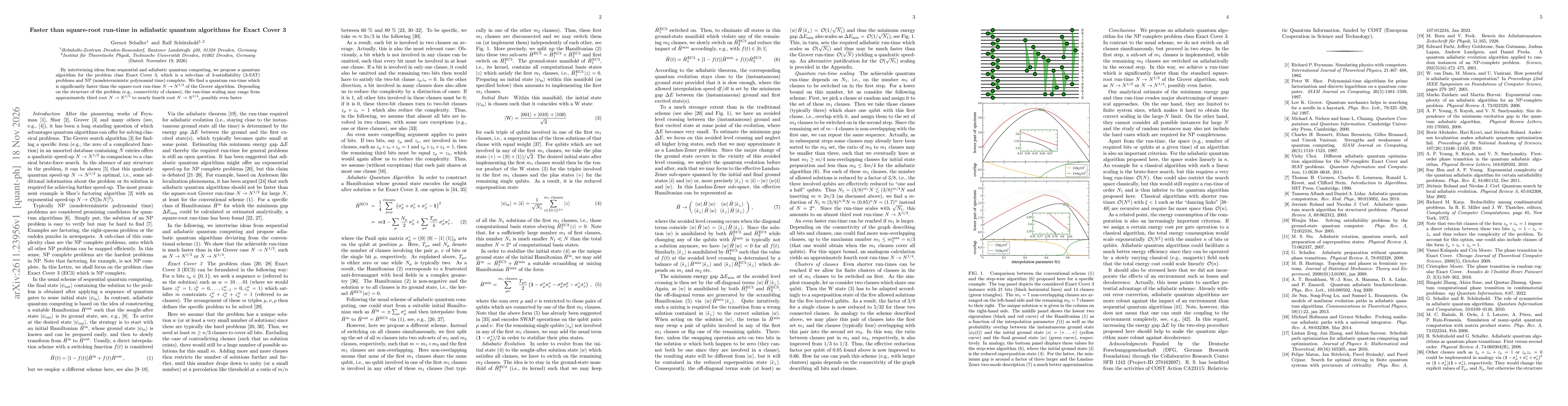
The authors propose a hybrid quantum algorithm that combines sequential and adiabatic quantum computing techniques. They split the Exact Cover 3 clauses into two subsets, first preparing a reduced superposition state using non‑overlapping clauses and a mixing Hamiltonian, then adiabatically switching on the remaining clauses while staying in the ground‑state manifold. The algorithm is further expressed as a modified Grover iteration on a reduced search space.
SignificanceWhy the work matters
Demonstrates that, for certain NP‑complete problems like Exact Cover 3, quantum algorithms can surpass the generic Grover limit by exploiting problem structure, suggesting new pathways for quantum speed‑ups beyond quadratic.
Technical contributionsWhat the work introduces
Introduces a novel adiabatic evolution scheme that interleaves non‑overlapping clause Hamiltonians with a mixing Hamiltonian, and maps the process to a modified Grover search on a reduced superposition, achieving sub‑square‑root scaling.
NoveltyHow it differs from prior work
The work uniquely combines sequential quantum gate constructions with a non‑standard adiabatic path, enabling clause‑wise Hamiltonian activation and a reduced‑space Grover iteration that yields run‑time scaling as low as N^{1/4}.
Future workQuestions that remain
- Provide a rigorous analytical proof of the claimed run‑time scaling.
- Explore the applicability of the hybrid scheme to other NP‑complete problems and different clause structures.
Discussion 0