Few-Shot Adaptation of Vision-Language Models via Agentic Model Editing
Abstract
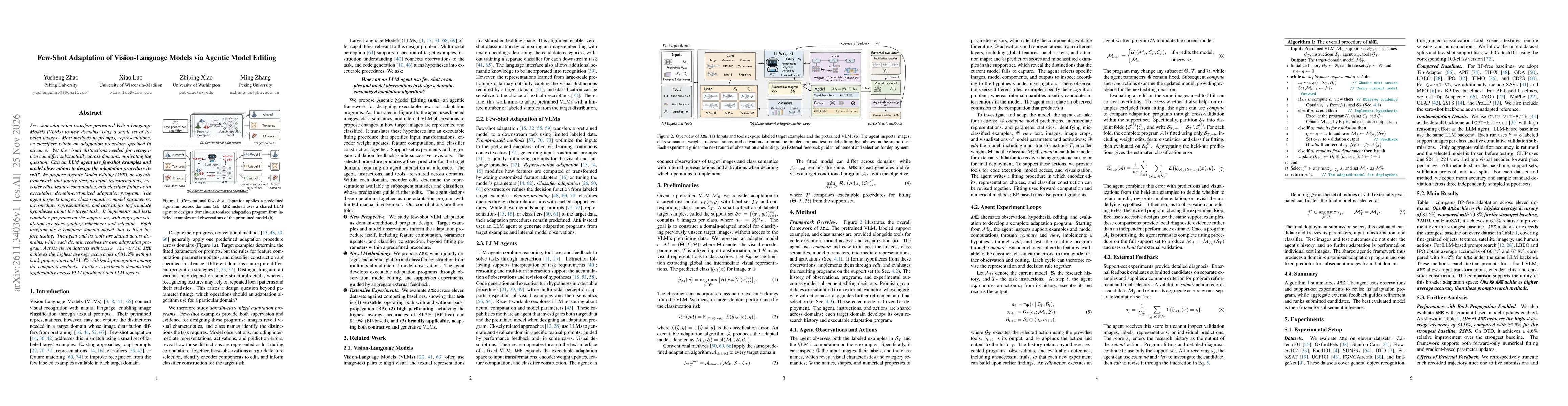
Few-shot adaptation transfers pretrained Vision-Language Models (VLMs) to new domains using a small set of labeled images. Most methods fit prompts, representations, or classifiers within an adaptation procedure specified in advance. Yet the visual distinctions needed for recognition can differ substantially across domains, motivating the question: Can an LLM agent use few-shot examples and model observations to design the adaptation procedure itself? We propose Agentic Model Editing (AME), an agentic framework that jointly designs input transformations, encoder edits, feature computation, and classifier fitting as an executable, domain-customized adaptation program. The agent inspects images, class semantics, model parameters, intermediate representations, and activations to formulate hypotheses about the target task. It implements and tests candidate programs on the support set, with aggregate validation accuracy guiding refinement and selection. Each program fits a complete domain model that is fixed before testing. The agent and its tools are shared across domains, while each domain receives its own adaptation program. Across eleven datasets with CLIP ViT-B/16, AME achieves the highest average accuracies of 81.2% without back-propagation and 81.9% with back-propagation among the compared methods. Further experiments demonstrate applicability across VLM backbones and LLM agents.
AI Key Findings
Get AI-generated insights about this paper's methodology, results, significance, and more — available when analysis has been generated.
Discussion 0