Few-shot Font Generation by Learning Style Difference and Similarity
This paper proposes a novel few-shot font generation method called DS-Font, which learns the differences between styles and similarities within the same style to generate target fonts with fewer samples. It employs contrastive learning, a multi-layer style projector, and a Cluster-level Contrastive Style loss to achieve superior results compared to existing methods.
Abstract
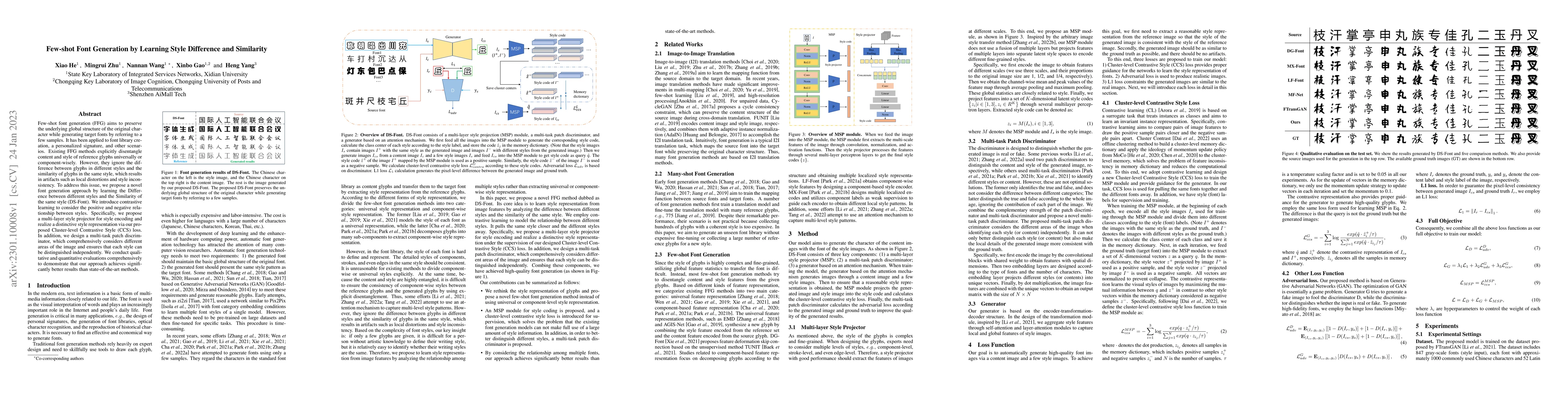
Few-shot font generation (FFG) aims to preserve the underlying global structure of the original character while generating target fonts by referring to a few samples. It has been applied to font library creation, a personalized signature, and other scenarios. Existing FFG methods explicitly disentangle content and style of reference glyphs universally or component-wisely. However, they ignore the difference between glyphs in different styles and the similarity of glyphs in the same style, which results in artifacts such as local distortions and style inconsistency. To address this issue, we propose a novel font generation approach by learning the Difference between different styles and the Similarity of the same style (DS-Font). We introduce contrastive learning to consider the positive and negative relationship between styles. Specifically, we propose a multi-layer style projector for style encoding and realize a distinctive style representation via our proposed Cluster-level Contrastive Style (CCS) loss. In addition, we design a multi-task patch discriminator, which comprehensively considers different areas of the image and ensures that each style can be distinguished independently. We conduct qualitative and quantitative evaluations comprehensively to demonstrate that our approach achieves significantly better results than state-of-the-art methods.
AI Key Findings
Get AI-generated insights about this paper's methodology, results, significance, and more — available when analysis has been generated.
Discussion 0