Few-Shot Open-Set Hyperspectral Pixel-Wise Classification with Spatial Aware Label Propagation
Abstract
Pixelwise classification of hyperspectral images (HSI) is a fundamental task in remote sensing, but its deployment in real-world applications is often limited by the scarcity of labeled data and the presence of unknown classes at inference time. In this work, we propose Few-shot Open-set hyperspectral recognition from Self-Supervised Learning training (FOSSeL), a unified framework for few-shot, open-set hyperspectral pixelwise classification that does not require supervised training. The proposed approach first leverages self-supervised learning to construct a discriminative feature space from unlabeled data. Then, given a small set of labeled seed pixels, class predictions are obtained through spatially-aware graph-based label propagation over superpixel representations, enabling the joint exploitation of spectral similarity and spatial consistency. To address the open-set scenario, we introduce simple yet effective strategies to identify pixels that do not belong to the known classes. We evaluate FOSSeL on three benchmark hyperspectral datasets under multiple few-shot settings. The results show that the proposed framework achieves competitive or superior performance compared to fully supervised methods while maintaining robustness in the presence of unknown classes. These findings highlight the potential of combining self-supervised feature learning with graph-based inference for practical HSI analysis in low-annotation and open-world scenarios.
Analysis
AI-generated · verify against the original paper
Generated Jan 1, 0001ResultsWhat the authors found
- The framework achieves competitive or superior accuracy compared to fully supervised state‑of‑the‑art methods on three benchmark hyperspectral datasets.
- FOSSeL remains robust in few‑shot settings and maintains performance when unknown classes are present at inference time.
LimitationsWhere the findings need caution
- The approach relies on superpixel segmentation, which may affect performance on images with complex spatial structures.
- Spectral unmixing of mixed pixels is not addressed, limiting applicability to sub‑pixel classification tasks.
MethodologyHow the work was done
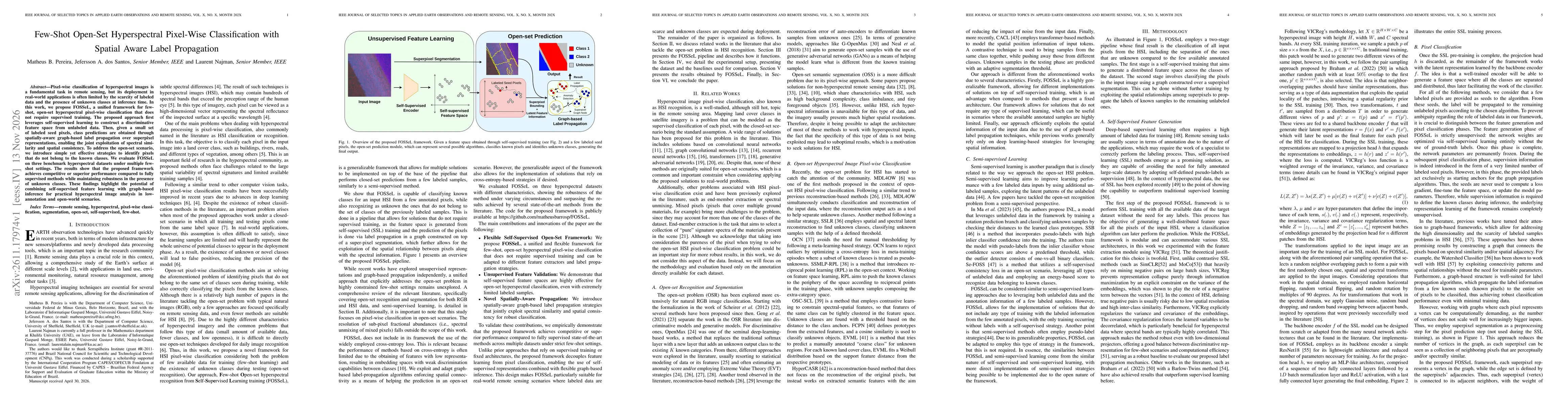
FOSSeL first trains a self‑supervised encoder on unlabeled hyperspectral data to obtain a discriminative feature space. Given a few labeled seed pixels, superpixel segmentation is performed and a spatially‑aware graph is built over superpixel nodes. Class labels are then propagated through graph‑based label propagation, while simple open‑set strategies detect unknown classes.
SignificanceWhy the work matters
The work demonstrates that self‑supervised feature learning combined with spatially aware graph propagation can effectively address both limited annotation and open‑set challenges in hyperspectral pixel‑wise classification, enabling practical deployment without supervised training.
Technical contributionsWhat the work introduces
A unified, flexible pipeline that decouples self‑supervised feature learning from graph‑based label propagation, enabling few‑shot, open‑set hyperspectral pixel‑wise classification without any supervised training.
NoveltyHow it differs from prior work
Introducing a spatially aware label propagation over superpixel graphs built on self‑supervised features, together with simple open‑set detection, to jointly tackle few‑shot learning and unknown class identification in hyperspectral imagery.
Future workQuestions that remain
- Explore integration of alternative self‑supervised encoders and cross‑entropy‑based strategies within the framework.
- Extend the method to handle spectral unmixing and sub‑pixel classification.
- Investigate more sophisticated open‑set detection mechanisms beyond the current simple strategies.
Discussion 0