This paper demonstrates that fidelity is a valuable probe for studying deconfined quantum critical points, confirming their continuous nature through the analysis of ground-state fidelity susceptibility using the density matrix renormalization group method. The study supports the existence of a deconfined quantum phase transition and provides a novel method to determine critical exponents.
Abstract
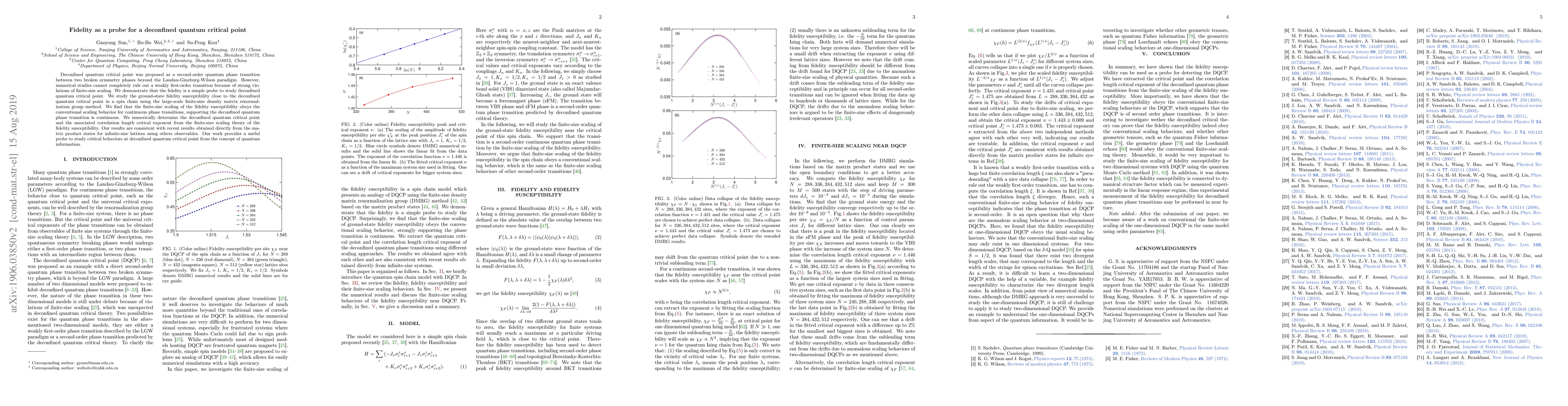
Deconfined quantum critical point was proposed as a second-order quantum phase transition between two broken symmetry phases beyond the Landau-Ginzburg-Wilson paradigm. However, numerical studies cannot completely rule out a weakly first-order transition because of strong violations of finite-size scaling. We demonstrate that the fidelity is a simple probe to study deconfined quantum critical point. We study the ground-state fidelity susceptibility close to the deconfined quantum critical point in a spin chain using the large-scale finite-size density matrix renormalization group method. We find that the finite-size scaling of the fidelity susceptibility obeys the conventional scaling behavior for continuous phase transitions, supporting the deconfined quantum phase transition is continuous. We numerically determine the deconfined quantum critical point and the associated correlation length critical exponent from the finite-size scaling theory of the fidelity susceptibility. Our results are consistent with recent results obtained directly from the matrix product states for infinite-size lattices using others observables. Our work provides a useful probe to study critical behaviors at deconfined quantum critical point from the concept of quantum information.
AI Key Findings
Get AI-generated insights about this paper's methodology, results, significance, and more — available when analysis has been generated.
Discussion 0