FIRE-Drive: Feasibility-Informed Risk Evaluation for End-to-End Diffusion Planning
Abstract
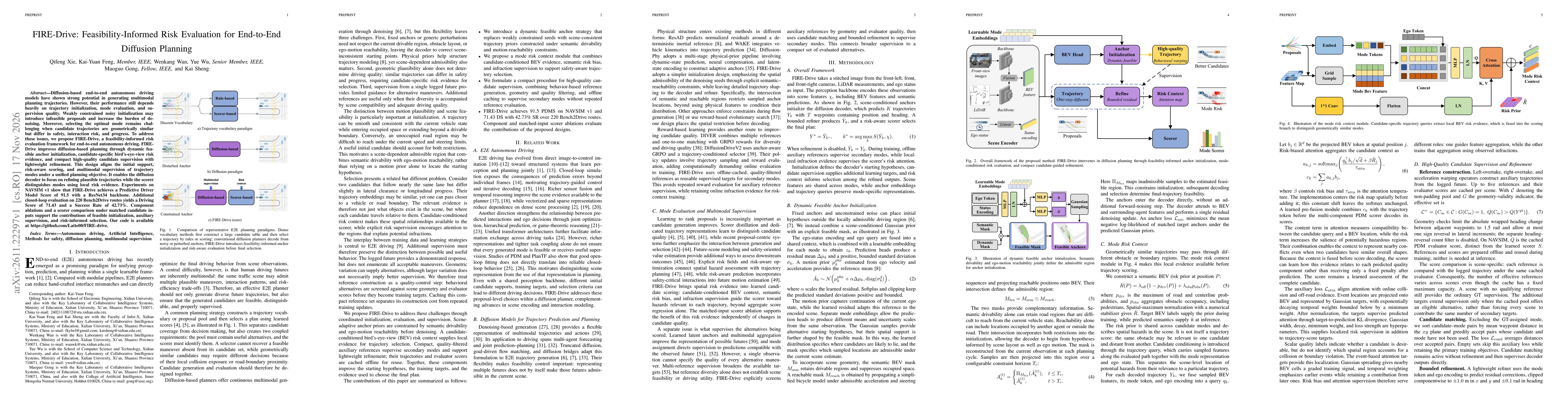
Diffusion-based end-to-end autonomous driving models have shown strong potential in generating multimodal planning trajectories. However, their performance still depends heavily on trajectory initialization, mode evaluation, and supervision quality. Weakly constrained noisy initialization may introduce infeasible proposals and increase the burden of denoising. Moreover, selecting the optimal mode remains challenging when candidate trajectories are geometrically similar but differ in safety, interaction risk, and progress. To address these issues, we propose FIRE-Drive, a feasibility-informed risk evaluation framework for end-to-end autonomous driving. FIRE-Drive improves diffusion-based planning through dynamic feasible anchor initialization, candidate-specific bird's-eye-view risk evidence, and compact high-quality candidate supervision with lightweight refinement. This design aligns the initial support, risk-aware scoring, and multimodal supervision of trajectory modes under a unified planning objective. It enables the diffusion decoder to focus on refining plausible trajectories while the scorer distinguishes modes using local risk evidence. Experiments on NAVSIM v1 show that FIRE-Drive achieves a Predictive Driver Model Score of 91.5 with a ResNet34 backbone. Additional closed-loop evaluation on 220 Bench2Drive routes yields a Driving Score of 71.43 and a Success Rate of 42.73%. Component ablations and a scorer comparison under matched candidate inputs support the contributions of feasible initialization, auxiliary supervision, and risk-informed selection. Our code is available at https://github.com/Latte00/FIRE-drive.
Analysis
AI-generated · verify against the original paper
Generated Jan 1, 0001ResultsWhat the authors found
- Predictive Driver Model Score (PDMS) of 91.5 on NAVSIM v1 with a ResNet34 backbone.
- Closed‑loop Driving Score of 71.43 and Success Rate of 42.73% on 220 Bench2Drive routes.
- Component ablations and scorer comparisons confirm the contributions of feasible initialization, risk‑informed selection, and auxiliary supervision.
LimitationsWhere the findings need caution
- Short‑horizon initialization constraints leave full‑horizon feasibility dependent on subsequent decoding and selection.
- The current single‑frame input limits temporal modeling capabilities.
- The auxiliary reference pool only covers a subset of possible behaviors, especially in highly interactive scenarios.
MethodologyHow the work was done
FIRE-Drive introduces a dynamic feasible anchor initialization constrained by semantic drivability and ego-motion reachability, a candidate‑specific bird’s‑eye‑view risk context module for risk‑aware scoring, and a compact high‑quality auxiliary candidate supervision with lightweight refinement, all integrated into a diffusion‑based end‑to‑end autonomous driving planner.
SignificanceWhy the work matters
The work demonstrates that feasibility‑informed trajectory priors and risk‑aware mode evaluation substantially improve the quality and safety of multimodal diffusion planning, narrowing the gap between open‑loop performance and closed‑loop driving behavior.
Technical contributionsWhat the work introduces
A unified planning objective that aligns dynamic feasible anchor generation, risk‑conditioned scoring, and compact multimodal supervision, enabling the diffusion decoder to focus on plausible trajectories while the scorer discriminates modes using local risk evidence.
NoveltyHow it differs from prior work
Introduces feasibility‑informed anchor initialization and candidate‑conditioned BEV risk context into diffusion‑based end‑to‑end autonomous driving, which were not present in prior diffusion planners.
Future workQuestions that remain
- Incorporate richer temporal modeling to capture longer‑term dynamics.
- Develop adaptive reference construction for more interactive driving situations.
Discussion 0