Five-loop \sqrt\epsilon-expansions for random Ising model and marginal spin dimensionality for cubic systems
This paper calculates five-loop \sqrt\epsilon-expansions for critical exponents in the weakly-disordered Ising model, revealing irregular coefficients. It also estimates the marginal spin dimensionality for cubic systems as n_c = 2.855 using Pade-Borel resummation.
Abstract
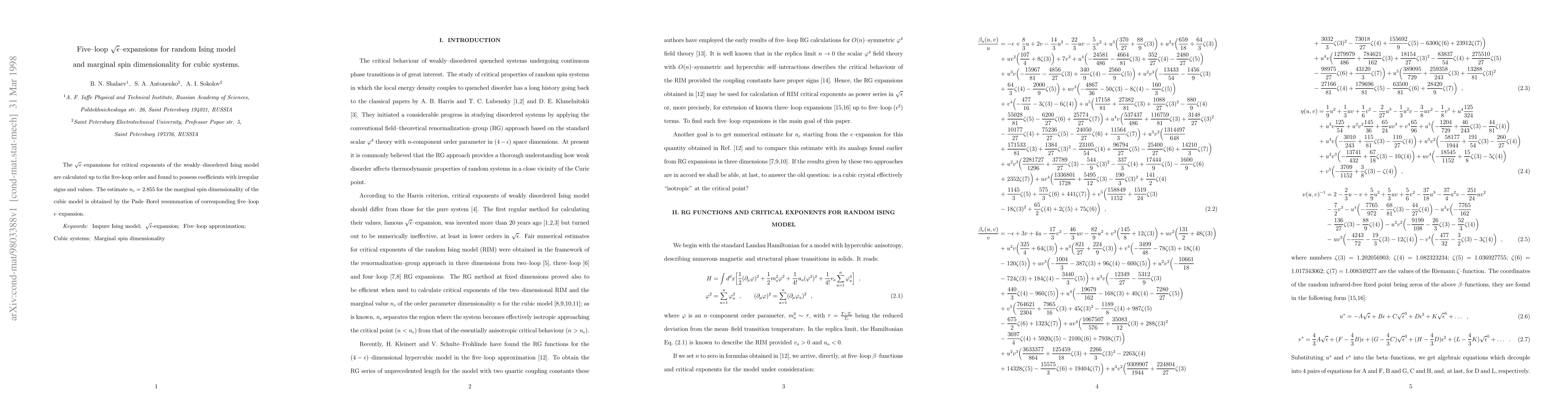
The \sqrt\epsilon-expansions for critical exponents of the weakly-disordered Ising model are calculated up to the five-loop order and found to possess coefficients with irregular signs and values. The estimate n_c = 2.855 for the marginal spin dimensionality of the cubic model is obtained by the Pade-Borel resummation of corresponding five-loop \epsilon-expansion.
Analysis
AI-generated · verify against the original paper
Generated Sep 4, 2025ResultsWhat the authors found
- Main finding: The series obtained exhibit irregular behavior, preventing summation by procedures based on the Borel transformation.
- Main finding 2: The √ǫ-expansions for critical exponents of the weakly disordered Ising model were calculated up to the five-loop order.
- Main finding 3: The results are in agreement with earlier studies and provide new insights into the critical behavior of the model.
LimitationsWhere the findings need caution
- Limitation 1: The irregular behavior of the series obtained prevents summation by standard procedures.
- Limitation 2: The results are sensitive to the order of approximation used.
MethodologyHow the work was done
The √ǫ-expansions for critical exponents of the weakly disordered Ising model were calculated up to the five-loop order using the Borel transformation.
SignificanceWhy the work matters
The research highlights the importance of studying the critical behavior of disordered systems and provides a new perspective on the Borel transformation method.
Technical contributionsWhat the work introduces
The calculation and analysis of the √ǫ-expansions provide new insights into the critical behavior of the weakly disordered Ising model.
NoveltyHow it differs from prior work
The research presents a novel approach to studying the critical behavior of disordered systems using the Borel transformation method.
Future workQuestions that remain
- Suggested direction 1: Further studies on the Borel transformation method for disordered systems.
- Suggested direction 2: Improving the numerical accuracy of the √ǫ-expansions for critical exponents.
Discussion 0