Floquet Green's functions for lattice electrons driven by Gaussian quantum light
This paper develops a theoretical framework to study lattice electrons driven by a prescribed quantum light source using Floquet Green's functions, capturing how a nonperturbative Peierls coupling to a Gaussian quantum drive shapes electronic dynamics. Numerics on a simple 1D model show quantum-source effects beyond classical drives, revealing how squeezing parameters and phase modify sidebands and electron occupation, enabling quantum Floquet engineering of materials.
Abstract
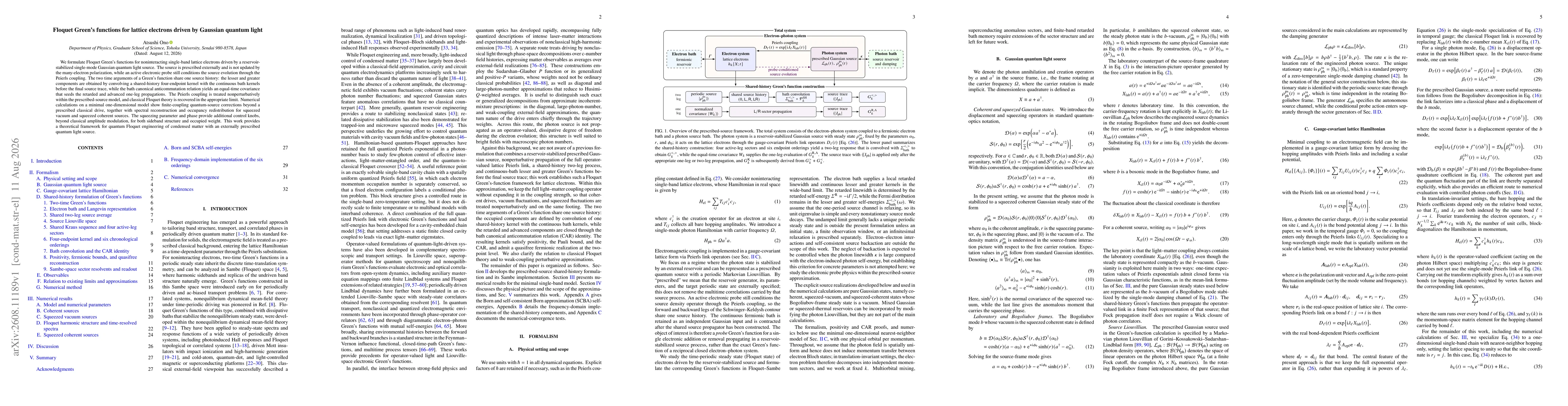
We formulate Floquet Green's functions for noninteracting single-band lattice electrons driven by a reservoir-stabilized single-mode Gaussian quantum light source. The source is prescribed externally and is not updated by the many-electron polarization, while an active electronic probe still conditions the source evolution through the Peierls coupling. The two time arguments of a Green's function share one source history: the lesser and greater components are obtained by convolving a shared-history four-endpoint kernel with the continuous bath kernels before the final source trace, while the bath canonical anticommutation relation yields an equal-time covariance that seeds the retarded and advanced one-leg propagations. The Peierls coupling is treated nonperturbatively within the prescribed-source model, and classical Floquet theory is recovered in the appropriate limit. Numerical calculations on a minimal one-dimensional model show finite-coupling quantum-source corrections beyond a prescribed classical drive, together with spectral reconstruction and occupancy redistribution for squeezed vacuum and squeezed coherent sources. The squeezing parameter and phase provide additional control knobs, beyond classical amplitude modulation, for both sideband structure and occupied weight. This work provides a theoretical framework for quantum Floquet engineering of condensed matter with an externally prescribed quantum light source.
Analysis
AI-generated · verify against the original paper
Generated Aug 13, 2026ResultsWhat the authors found
- Finite-coupling quantum-source corrections emerge beyond the prescribed classical drive, altering spectral features and occupancy distributions.
- Spectral reconstruction reveals sideband modifications and redistribution of occupied weight influenced by squeezing parameter and phase.
- Squeezed vacuum and squeezed coherent states provide additional control knobs for Floquet sidebands beyond classical amplitude modulation.
- The framework yields a positive, physical (Pauline-bounded, CAR-consistent) quasifree two-point structure despite fully operator-valued light-matter coupling.
LimitationsWhere the findings need caution
- Analysis is limited to noninteracting single-band lattice electrons; many-body interactions are not addressed in this work.
- Numerical results are demonstrated on a minimal 1D model; extensions to higher dimensions and realistic material parameters are not shown.
- Prescribed-source assumption neglects back-action of electronic polarization on the source dynamics beyond the shared-history kernel.
MethodologyHow the work was done
A reservoir-stabilized prescribed Gaussian quantum light source is imposed on a noninteracting single-band lattice, with nonperturbative Peierls coupling between light and electrons. The two-time Green's function uses a shared-history four-endpoint kernel and bath kernels to construct lesser/greater components, while CAR relations close retarded/advanced propagations. Quantum light is treated operator-valued and not integrated out; classical Floquet theory is recovered in the appropriate limit. Numerical evaluation is performed on a minimal 1D model to explore quantum-source corrections beyond a prescribed classical drive and to reconstruct spectra and occupancies under squeezed vacuum and squeezed coherent sources.
SignificanceWhy the work matters
The work provides a formal quantum Floquet framework linking externally prescribed quantum light sources to lattice electron dynamics, enabling quantum Floquet engineering with nonperturbative light–matter coupling and reservoir stabilization, and bridging classical Floquet theory with quantum-optical control in condensed matter systems.
Technical contributionsWhat the work introduces
Introduction of a formalism that combines a reservoir-stabilized prescribed Gaussian quantum light source with a nonperturbative, operator-valued Peierls coupling, using a shared-history four-endpoint kernel to compute lesser/greater Green’s functions and a CAR-based closure for retarded/advanced components, enabling quantum Floquet Green’s functions for lattice electrons.
NoveltyHow it differs from prior work
First explicit Floquet Green’s-function framework for lattice electrons driven by an externally prescribed quantum Gaussian light source, with nonperturbative light–matter coupling, shared-history two-leg structure, and continuous-bath lesser/greater components leading to a consistent quasifree electronic description under quantum driving.
Future workQuestions that remain
- Extend to interacting electron models (e.g., Hubbard-type) to study correlation-driven quantum Floquet phenomena.
- Generalize to multi-band lattices and explore interband coherence under quantum light driving.
- Investigate dynamics beyond steady-state via time-dependent protocols and different reservoir stabilizations.
- Develop experimental proposals to realize reservoir-stabilized Gaussian quantum light sources in solid-state or circuit-QED platforms.
Discussion 0