FlyVQA: Seeing Video Frame Interpolation Quality through Fly Eyes
Abstract
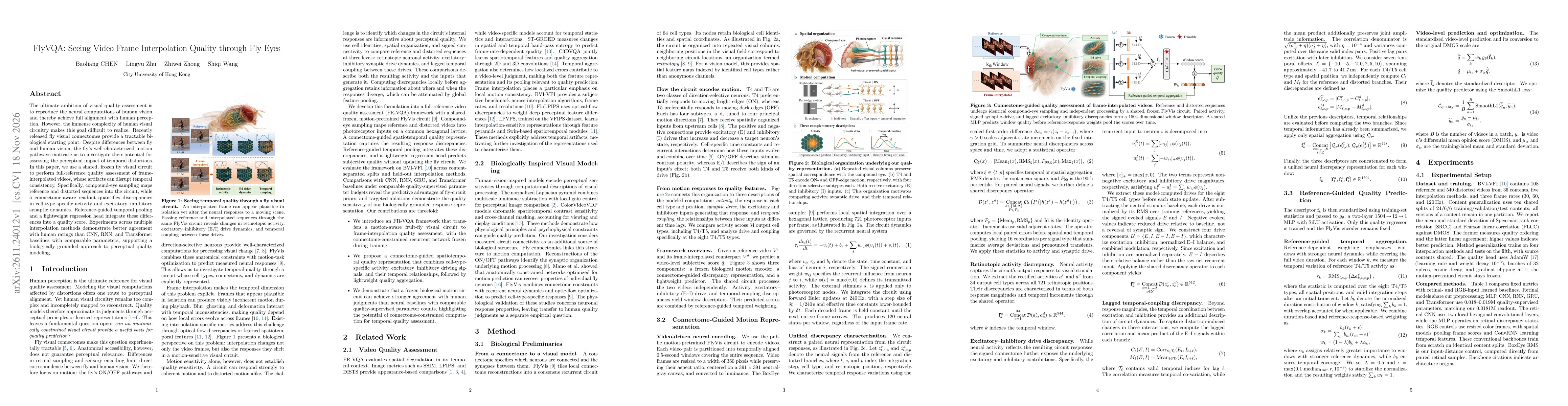
The ultimate ambition of visual quality assessment is to reproduce the neural computations of human vision and thereby achieve full alignment with human perception. However, the immense complexity of human visual circuitry makes this goal difficult to realize. Recently released fly visual connectomes provide a tractable biological starting point. Despite differences between fly and human vision, the fly's well-characterized motion pathways motivate us to investigate their potential for assessing the perceptual impact of temporal distortions. In this paper, we use a shared, frozen fly visual circuit to perform full-reference quality assessment of frame-interpolated videos, whose artifacts can disrupt temporal consistency. Specifically, compound-eye sampling maps reference and distorted sequences into the circuit, while a connectome-aware readout quantifies discrepancies in cell-type-specific activity and excitatory--inhibitory synaptic dynamics. Reference-guided temporal pooling and a lightweight regression head integrate these differences into a quality score. Experiments across multiple interpolation methods demonstrate better agreement with human ratings than CNN, RNN, and Transformer baselines with comparable parameters, supporting a biologically grounded approach to perceptual quality modeling.
Analysis
AI-generated · verify against the original paper
Generated Jan 1, 0001ResultsWhat the authors found
- FlyVQA achieves higher correlation with human quality ratings than CNN, RNN, GRU, and Transformer baselines while using comparable parameter budgets.
- On the BVI‑VFI benchmark, the framework improves average agreement with human judgments over all evaluated baselines.
- When evaluated on the CGVQD dataset without adaptation, FlyVQA attains 0.634 SRCC, lower than its 0.833 SRCC on interpolation tasks, indicating reduced performance on heterogeneous distortions.
LimitationsWhere the findings need caution
- The frozen motion circuit is specialized for interpolation artifacts and does not generalize as well to other distortion types, as shown by the performance gap on CGVQD.
- No adaptation or fine‑tuning of the fly circuit is performed, limiting its flexibility across diverse video quality tasks.
MethodologyHow the work was done
The authors employ a shared, frozen fly visual circuit (FlyVis) to perform full‑reference video quality assessment of frame‑interpolated videos. Reference and distorted video sequences are mapped into the circuit via compound‑eye sampling, and a connectome‑aware readout quantifies discrepancies in cell‑type‑specific activity, excitatory‑inhibitory synaptic dynamics, and temporal coupling. These differences are aggregated using reference‑guided temporal pooling and a lightweight regression head to produce a quality score.
SignificanceWhy the work matters
This work demonstrates that a biologically grounded, motion‑aware fly visual circuit can serve as an effective prior for perceptual video quality modeling, bridging connectome‑based neuroscience and computer vision to improve alignment with human perception.
Technical contributionsWhat the work introduces
The paper introduces an FR‑VQA framework that transfers a motion‑aware fruit‑fly visual circuit to video frame interpolation quality assessment, proposes a connectome‑guided spatiotemporal representation combining cell‑type activity, excitatory‑inhibitory dynamics, and temporal relationships, and demonstrates lightweight quality prediction without updating the biological circuit.
NoveltyHow it differs from prior work
It is the first study to leverage a connectome‑constrained fly visual circuit for full‑reference video quality assessment of frame‑interpolated content, providing a novel biologically inspired alternative to conventional deep learning baselines.
Future workQuestions that remain
- Integrate learnable spatial features with the biological motion responses to enhance generalization across distortion types.
- Explore fine‑tuning or adapting the fly visual circuit for broader video quality assessment scenarios.
- Extend the approach to evaluate other forms of temporal and spatial video distortions beyond frame interpolation.
Discussion 0