FoRe: A Force-Guided Framework for Autonomous Grasp Recovery in Vision-Language-Action Models
Abstract
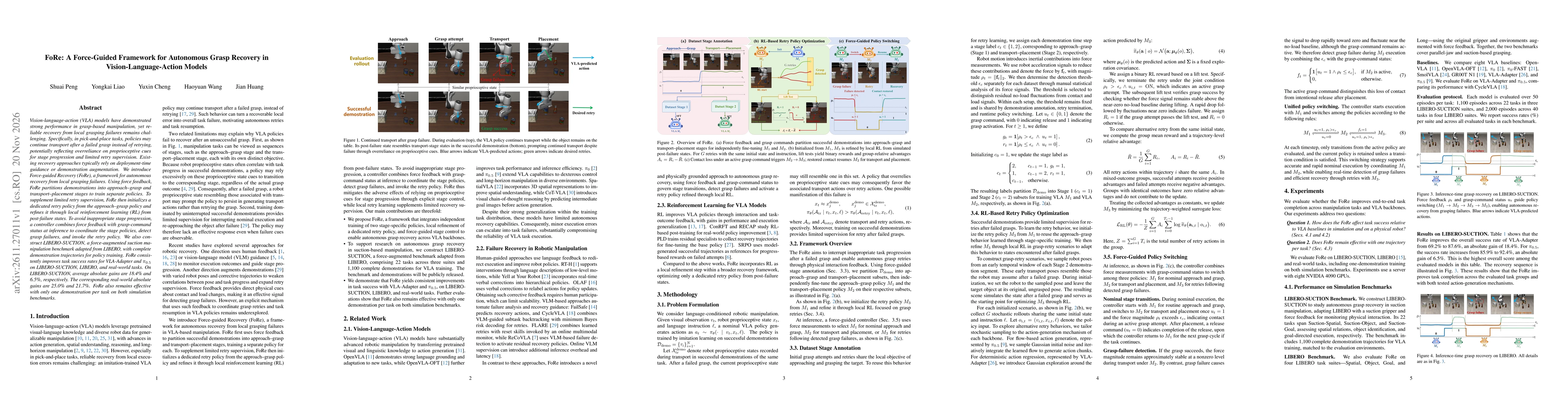
Vision-language-action (VLA) models have demonstrated strong performance in grasp-based manipulation, yet reliable recovery from local grasping failures remains challenging. Specifically, in pick-and-place tasks, policies may continue transport after a failed grasp instead of retrying, potentially reflecting overreliance on proprioceptive cues for stage progression and limited retry supervision. Existing recovery approaches typically rely on deployment-time guidance or demonstration augmentation. We introduce Force-guided Recovery (FoRe), a framework for autonomous recovery from local grasping failures. Using force feedback, FoRe partitions demonstrations into approach-grasp and transport-placement stages to train separate policies. To supplement limited retry supervision, FoRe then initializes a dedicated retry policy from the approach-grasp policy and refines it through local reinforcement learning (RL) from post-failure states. To avoid inappropriate stage progression, a controller combines force feedback with grasp-command status at inference to coordinate the stage policies, detect grasp failures, and invoke the retry policy. We also construct LIBERO-SUCTION, a force-augmented suction manipulation benchmark adapted from LIBERO, with complete demonstration trajectories for policy training. FoRe consistently improves task success rates for VLA-Adapter and $π_{0.5}$ on LIBERO-SUCTION, LIBERO, and real-world tasks. On LIBERO-SUCTION, average absolute gains are 18.4% and 6.5%, respectively. The corresponding real-world absolute gains are 25.0% and 21.7%. FoRe also remains effective with only one demonstration per task on both simulation benchmarks.
Analysis
AI-generated · verify against the original paper
Generated Jan 1, 0001ResultsWhat the authors found
- FoRe improves task success rates for VLA‑Adapter and π0.5 on LIBERO‑SUCTION, LIBERO, and real‑world tasks.
- On LIBERO‑SUCTION, average absolute gains are 18.4% for VLA‑Adapter and 6.5% for π0.5.
- Corresponding real‑world gains are 25.0% for VLA‑Adapter and 21.7% for π0.5.
- FoRe remains effective with only one demonstration per task on both simulation benchmarks.
MethodologyHow the work was done
FoRe uses force feedback to split demonstration trajectories into approach‑grasp and transport‑placement stages, training separate policies for each. A dedicated retry policy is initialized from the approach‑grasp policy and refined via local reinforcement learning from post‑failure states. At inference, a controller combines force feedback with grasp‑command status to detect grasp failures, coordinate stage policies, and invoke the retry policy.
SignificanceWhy the work matters
The framework enables autonomous recovery from local grasp failures, addressing overreliance on proprioceptive cues and limited retry supervision, thereby substantially increasing the reliability of vision‑language‑action manipulation systems.
Technical contributionsWhat the work introduces
Introduces a force‑guided recovery framework that partitions demonstrations, trains stage‑specific policies, and refines a retry policy via local RL, together with a controller that uses force feedback to manage stage transitions and failure detection.
NoveltyHow it differs from prior work
First integration of force feedback for explicit stage control and autonomous grasp‑retry learning within vision‑language‑action models.
Discussion 0