Forget the Lineage: Forward-Secure, Lineage-Complete Cryptographic Erasure for LLM-Agent Memory
Abstract
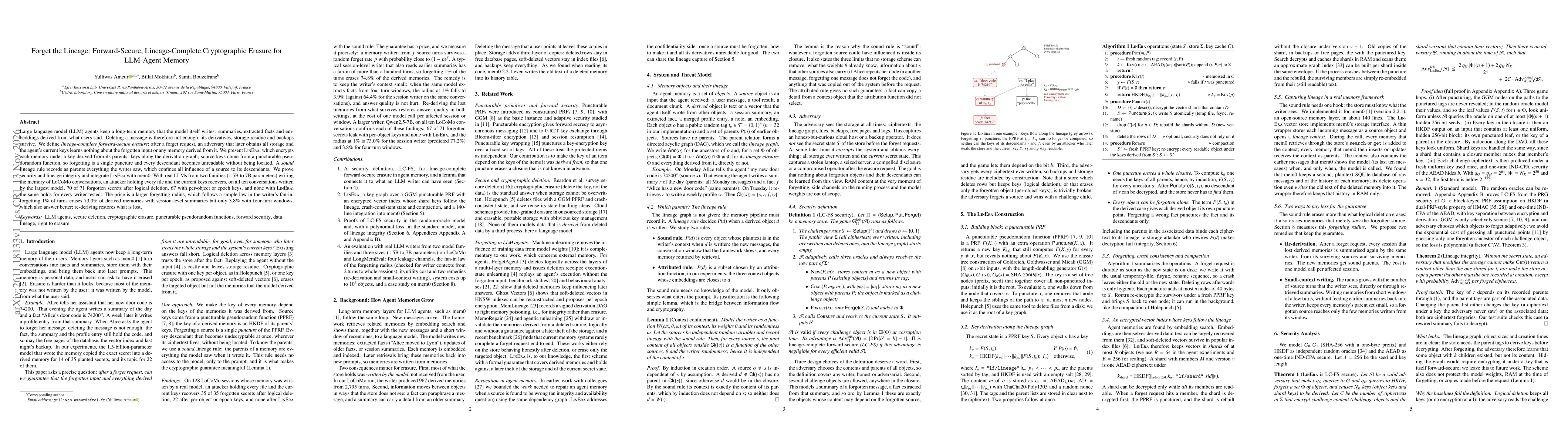
Large language model (LLM) agents keep a long-term memory that the model itself writes: summaries, extracted facts and embeddings derived from what users said. Deleting a message is therefore not enough: its derivatives, storage residue and backups survive. We define lineage-complete forward-secure erasure: after a forget request, an adversary that later obtains all storage and the agent's current keys learns nothing about the forgotten input or any memory derived from it. We present LinEra, which encrypts each memory under a key derived from its parents' keys along the derivation graph; source keys come from a puncturable pseudorandom function, so forgetting is a single puncture and every descendant becomes unreadable without being located. A sound lineage rule records as parents everything the writer saw, which confines all influence of a source to its descendants. We prove security and lineage integrity and integrate LinEra with mem0. With real LLMs from two families (1.5B to 7B parameters) writing the memory of LoCoMo conversations, an attacker holding every file and the current keys recovers, on all ten conversations written by the largest model, 70 of 71 forgotten secrets after logical deletion, 67 with per-object or epoch keys, and none with LinEra; the same holds for every writer tested. The price is a larger forgetting radius, which follows a simple law in the writer's fan-in: forgetting 1% of turns erases 73.0% of derived memories with session-level summaries but only 3.8% with four-turn windows, which also answer better; re-deriving restores what is lost.
Analysis
AI-generated · verify against the original paper
Generated Jan 1, 0001ResultsWhat the authors found
- An attacker with full storage and current keys recovers 70 of 71 forgotten secrets after logical deletion, 67 with per-object or epoch keys, and none with LinEra.
- Forgetting 1% of turns erases 73.0% of derived memories with session-level summaries but only 3.8% with four‑turn windows.
- Re‑deriving lost memories restores answer quality, incurring only one model call per affected session or window.
- The forgetting radius follows a simple law based on the writer's fan‑in, confirming the trade‑off between privacy and utility.
LimitationsWhere the findings need caution
- The scheme incurs a larger forgetting radius, potentially erasing many derived memories depending on the writer's fan‑in.
- Utility can be reduced unless the writer’s context is kept small (e.g., using four‑turn windows).
- Re‑derivation to recover lost utility adds extra model inference cost.
MethodologyHow the work was done
The authors design LinEra, encrypting each memory object with a key derived from its parents' keys in the derivation graph using a puncturable pseudorandom function (PPRF). A sound lineage rule records all inputs seen by the writer as parents, ensuring that forgetting a source via a single puncture renders all descendants unreadable. They prove security and lineage integrity in the random-oracle and standard models, integrate the scheme with the mem0 system, and evaluate it on real LLM agents (1.5B–7B parameters) across multiple conversation datasets.
SignificanceWhy the work matters
LinEra provides the first formal, forward‑secure, lineage‑complete cryptographic erasure for LLM‑agent memories, guaranteeing that forgotten inputs and all their derivatives remain unrecoverable even after full storage compromise.
Technical contributionsWhat the work introduces
Definition of lineage‑complete forward‑secure erasure (LC‑FS), the LinEra construction using a GGM‑based puncturable PRF with hierarchical key derivation, formal security and lineage‑integrity proofs, and a practical integration and evaluation within the mem0 memory system.
NoveltyHow it differs from prior work
Introduces the first scheme that formally guarantees erasure of both original inputs and all derived memory objects against an adversary with full storage access, leveraging a novel lineage rule and puncturable PRF‑based key graph.
Discussion 0