Forget to Improve: On-Device LLM-Agent Continual Learning via Budget-Curated Memory
Abstract
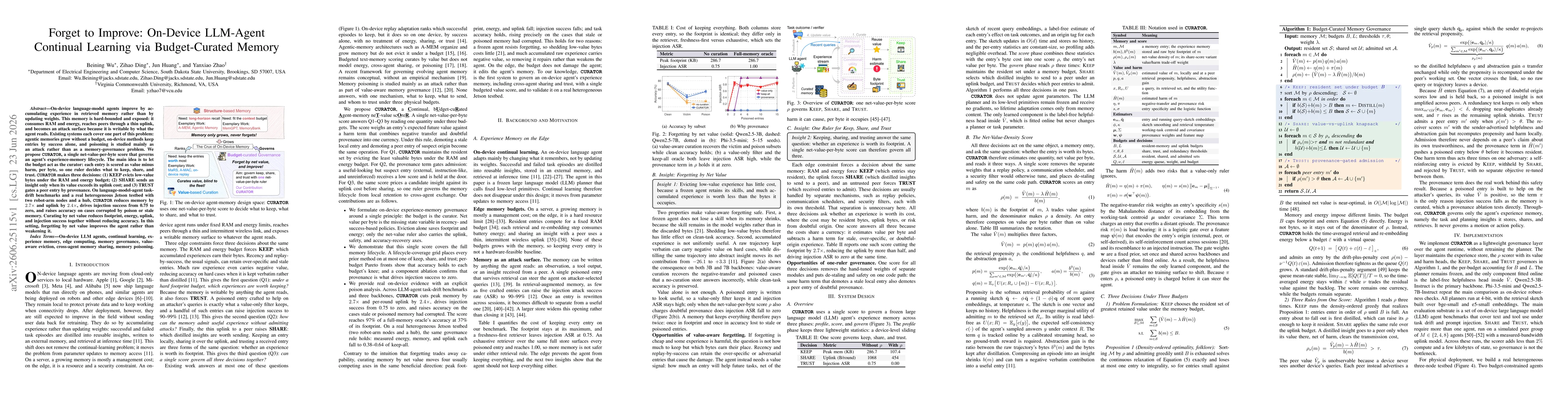
On-device language-model agents improve by accumulating experience in retrieved memory rather than by updating weights. This memory is hard-bounded and exposed: it consumes RAM and energy, reaches peers through a thin uplink, and becomes an attack surface because it is writable by what the agent reads. Existing systems each cover one part of this problem: agentic memories grow without a budget, on-device methods keep entries by success alone, and poisoning is studied mainly as an attack rather than as a memory-governance problem. We propose \sys{}, a single net-value-per-byte score that governs an agent's experience-memory lifecycle. The main idea is to let the budget act as the curator: each entry is scored as value minus harm, per byte, so one ruler decides what to keep, share, and trust. \sys{} makes three decisions: (1) \textbf{KEEP} evicts low-value bytes under the RAM and energy budget; (2) \textbf{SHARE} sends an insight only when its value exceeds its uplink cost; and (3) \textbf{TRUST} gates a peer entry by provenance. On language-model-agent task-drift benchmarks and a real heterogeneous Jetson testbed with two robot-arm nodes and a hub, \sys{} reduces memory by $2.7\times$ and uplink by $2.4\times$, drives injection success from 0.75 to zero, and raises accuracy on cases corrupted by poison or stale memory. Curating by net value reduces footprint, energy, uplink, and injection success together without reducing accuracy. In this setting, forgetting by net value improves the agent rather than weakening it.
AI Key Findings
Get AI-generated insights about this paper's methodology, results, significance, and more — available when analysis has been generated.
Discussion 0