From Acting to Learning: Experience Selection toward Continually Learning Agents
Abstract
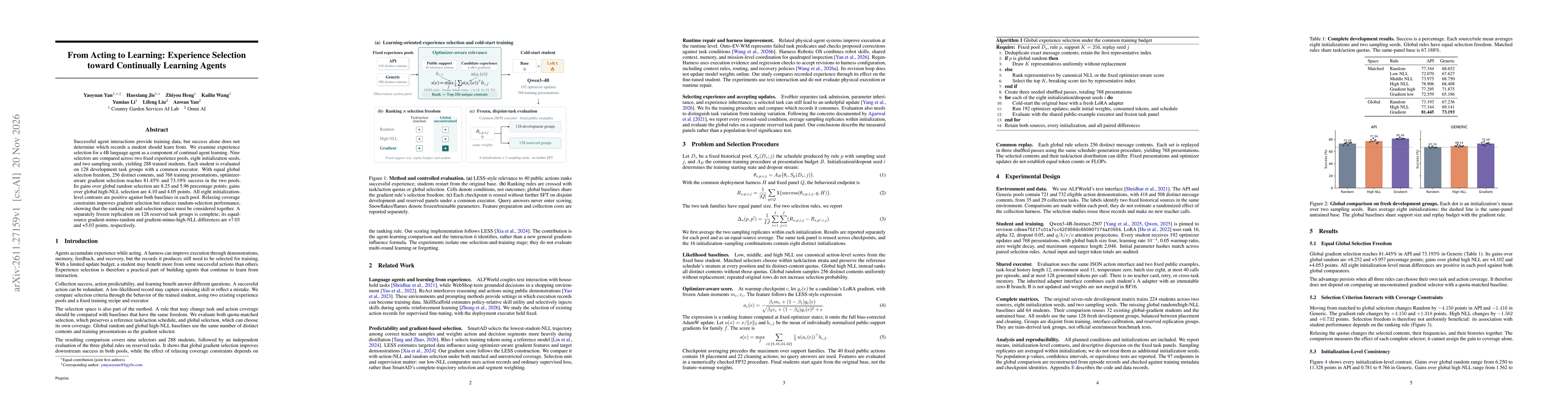
We study how selection rules and coverage constraints affect what a 4B language agent learns from successful interactions. The comparison covers nine selectors, two fixed experience pools, eight initialization seeds, and two sampling seeds, producing 288 trained students. Each student is evaluated on 128 development task groups with the same executor. With equal global selection freedom, 256 distinct contents, and 768 training presentations, optimizer-aware gradient selection reaches 81.45\% and 73.19\% success in the two pools. It improves on global random selection by 8.25 and 5.96 percentage points, and on global high-NLL selection by 4.10 and 4.05 points. All eight initialization-level contrasts are positive against both baselines in each pool. Relaxing task/action quotas improves gradient selection but lowers random-selection performance: the benefit of selection freedom depends on the ranking rule. A separately frozen replication on 128 reserved task groups is complete; gradient selection gains +7.03 points over random and +5.03 over high NLL after averaging the two pools equally.
Analysis
AI-generated · verify against the original paper
Generated Jan 1, 0001ResultsWhat the authors found
- Optimizer-aware gradient selection achieves 81.45% and 73.19% success in the two pools, outperforming global random selection by 8.25 and 5.96 percentage points.
- Gradient selection also surpasses global high-NLL selection by 4.10 and 4.05 points in the respective pools.
- All eight initialization-level contrasts are positive against both baselines in each pool.
- Relaxing coverage constraints improves gradient selection performance but reduces random-selection performance.
- A frozen replication on 128 reserved task groups shows gradient-minus-random and gradient-minus-high-NLL differences of +7.03 and +5.03 points.
LimitationsWhere the findings need caution
- The experiments isolate a single selection-and-training stage and do not evaluate multi-round learning or forgetting.
- The study is limited to simulated ALFWorld and WebShop tasks and does not include real-world human-subject experiments.
MethodologyHow the work was done
The study compares nine experience selectors on two fixed experience pools for a 4B language agent, using eight initialization seeds and two sampling seeds, resulting in 288 trained student agents evaluated on 128 development task groups with a common executor. Selections are made under equal global selection freedom with 256 distinct contents and 768 training presentations, employing optimizer-aware gradient selection, global random selection, and global high-NLL selection as baselines.
SignificanceWhy the work matters
The results demonstrate that optimizer-aware gradient-based experience selection substantially improves downstream success of continually learning agents compared to random or high-NLL baselines, highlighting the importance of the ranking rule and selection space in experience selection.
Technical contributionsWhat the work introduces
A comprehensive empirical comparison of nine experience selectors, including an optimizer-aware gradient selector based on LESS-style scoring, across extensive controlled experiments with fixed pools, seeds, and evaluation protocols.
NoveltyHow it differs from prior work
Introducing and evaluating optimizer-aware gradient selection for experience selection in continual learning agents, showing its advantage over traditional random and high-NLL baselines under matched selection freedoms.
Future workQuestions that remain
- Extending the evaluation to multi-round continual learning scenarios to assess forgetting and long-term retention.
- Applying the selection framework to broader domains and real-world interaction settings.
Discussion 0