From Autonomous Agents to Cognitive Symbionts: Toward AI-Augmented Human Intelligence
Abstract
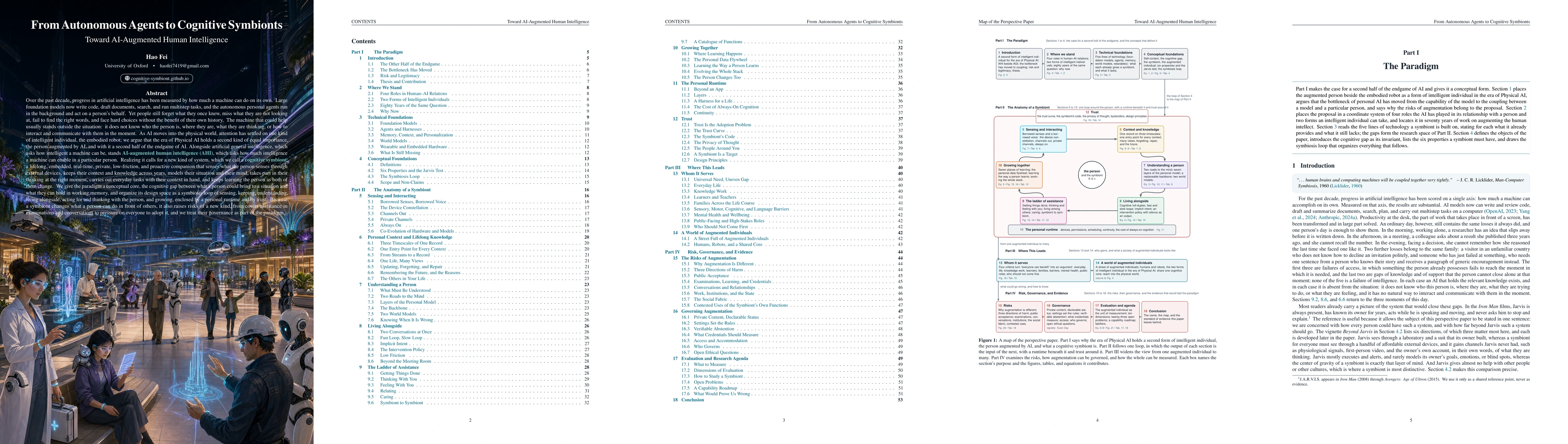
For a decade, progress in artificial intelligence has been measured by how much a machine can do on its own. Large foundation models now write code and run multistep tasks, and personal agents act on a person's behalf. Yet people still forget what they once knew, miss what they are not looking at, fail to find the right words, and face hard choices without the benefit of their own history, because the machine that could help stands outside the situation. As AI moves into the physical world, attention has settled on one kind of intelligent individual, the embodied robot; we argue that the era of Physical AI holds a second kind of equal importance, the person augmented by AI. Alongside artificial general intelligence, which asks how intelligent a machine can be, stands AI-augmented human intelligence (AHI), which asks how much intelligence a machine can enable in a particular person. Realizing it calls for a new kind of system, a cognitive symbiont: a lifelong, embedded, real-time, private, low-friction, and proactive companion that senses what the person senses through external devices, keeps their context across years, models their situation and their mind, takes part in their thinking at the right moment, carries out everyday tasks with their context, and keeps learning the person as both change. We give the paradigm a conceptual core, the cognitive gap between what a person could bring to a situation and what they can hold in working memory, and organize its design space as a symbiosis loop of sensing, keeping, understanding, living alongside, acting for and thinking with the person, and growing, enclosed by a personal runtime and by trust. Because a symbiont changes what a person can do in front of others, it also raises risks of a new kind, from covert assistance in examinations to pressure on everyone to adopt it, and we treat their governance as part of the paradigm.
Analysis
AI-generated · verify against the original paper
Generated Jan 1, 0001ResultsWhat the authors found
- The cognitive symbiont paradigm is defined as a lifelong, embedded, real‑time, private, low‑friction, proactive companion that senses the user, maintains context across years, models situation and mind, and assists in thinking and tasks.
- A conceptual core, the cognitive gap, is introduced to quantify the difference between what a person can bring to a situation and what they can hold in working memory.
- The design space is mapped as a symbiosis loop with seven stages, and a ladder of assistance is described ranging from doing errands to thinking and feeling with the user.
LimitationsWhere the findings need caution
- The paper provides a high‑level conceptual framework without empirical validation or prototype implementations.
- Governance and ethical risks, such as covert assistance and pressure to adopt, are identified but not resolved.
MethodologyHow the work was done
The authors conduct a conceptual analysis and design of a new AI system called a cognitive symbiont, outlining its properties (lifelong, embedded, real-time, private, low‑friction, proactive) and organizing its design space as a symbiosis loop of sensing, keeping, understanding, living alongside, acting for, thinking with, and growing, supported by a personal runtime and trust framework.
SignificanceWhy the work matters
The work reframes AI progress from building more autonomous machines to augmenting individual human intelligence, proposing a concrete paradigm for AI‑augmented human intelligence that could transform personal productivity, decision‑making, and learning.
Technical contributionsWhat the work introduces
Introduction of the cognitive symbiont paradigm, including the cognitive gap concept, the symbiosis loop design, and a comprehensive map of system components and open research problems for AI‑augmented human intelligence.
NoveltyHow it differs from prior work
The paper uniquely positions AI‑augmented human intelligence as a distinct research agenda from autonomous AI, proposing a lifelong, personal AI companion (cognitive symbiont) that actively augments individual cognition.
Future workQuestions that remain
- Develop concrete implementations to address open problems in context and knowledge modeling at scale (A1).
- Create grounded mind‑modeling approaches that fuse observation and self‑report data (A2).
- Design mechanisms for handling multiple selves and preventing collapse into an average persona (A3).
- Build joint physical and mental world models that learn from first‑person streams (A4).
- Investigate low‑latency, real‑time operation across sensor, edge, and cloud layers (B7).
- Explore governance frameworks for assistance policies, verifiable abstention, and disclosure of assistance records (F19‑F23).
Discussion 0