From Cases to Criteria: Reusing Evaluation Knowledge for Task-Specific Rubric Generation
Abstract
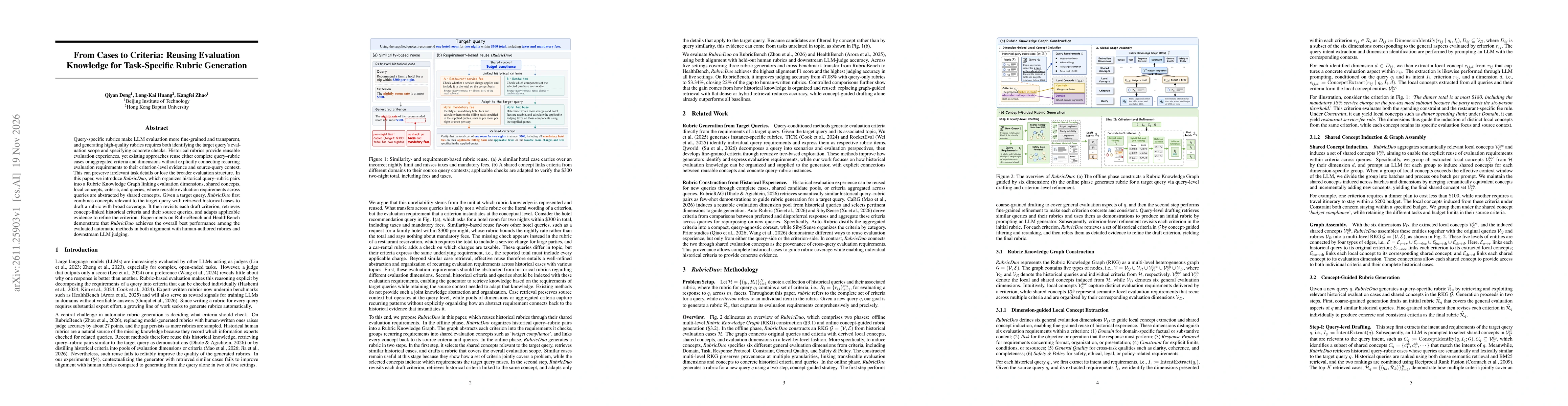
Query-specific rubrics make LLM evaluation more fine-grained and transparent, and generating high-quality rubrics requires both identifying the target query's evaluation scope and specifying concrete checks. Historical rubrics provide reusable evaluation experiences, yet existing approaches reuse either complete query-rubric cases or aggregated criteria and dimensions without explicitly connecting recurring evaluation requirements to their criterion-level evidence and source-query context. This can preserve irrelevant task details or lose the broader evaluation structure. In this paper, we introduce RubricDuo, which organizes historical query-rubric pairs into a Rubric Knowledge Graph linking evaluation dimensions, shared concepts, local concepts, criteria, and queries, where reusable evaluation requirements across queries are abstracted by shared concepts. Given a target query, RubricDuo first combines concepts relevant to the target query with retrieved historical cases to draft a rubric with broad coverage. It then revisits each draft criterion, retrieves concept-linked historical criteria and their source queries, and adapts applicable evidence to refine the criterion. Experiments on RubricBench and HealthBench demonstrate that RubricDuo achieves the overall best performance among the evaluated automatic methods in both alignment with human-authored rubrics and downstream LLM judging.
Analysis
AI-generated · verify against the original paper
Generated Jan 1, 0001ResultsWhat the authors found
- RubricDuo achieves the overall best performance among evaluated automatic methods on both RubricBench and HealthBench.
- It shows higher alignment with human‑authored rubrics and improves downstream LLM judging accuracy compared to similarity‑based reuse approaches.
MethodologyHow the work was done
RubricDuo constructs a Rubric Knowledge Graph that links evaluation dimensions, shared concepts, local concepts, criteria, and queries from historical query‑rubric pairs; given a target query it first drafts a rubric by combining relevant shared concepts with retrieved cases, then refines each draft criterion by retrieving concept‑linked historical criteria and adapting their evidence with source‑query context.
SignificanceWhy the work matters
The approach enables systematic reuse of evaluation knowledge across tasks, producing higher‑quality, query‑specific rubrics that make LLM evaluation more fine‑grained and transparent.
Technical contributionsWhat the work introduces
Introduction of a Rubric Knowledge Graph for organizing historical rubric knowledge and a two‑step generation process that first drafts broad coverage rubrics using shared concepts and then refines criteria with concept‑linked historical evidence.
NoveltyHow it differs from prior work
Unlike prior methods that reuse whole query‑rubric cases or aggregate dimensions, RubricDuo abstracts recurring evaluation requirements into shared concepts and explicitly connects them to source criteria and queries for requirement‑based rubric generation.
Discussion 0