From Local Errors to System Failures: Modeling and Benchmarking Error Propagation in Multi-Agent LLM Systems
Abstract
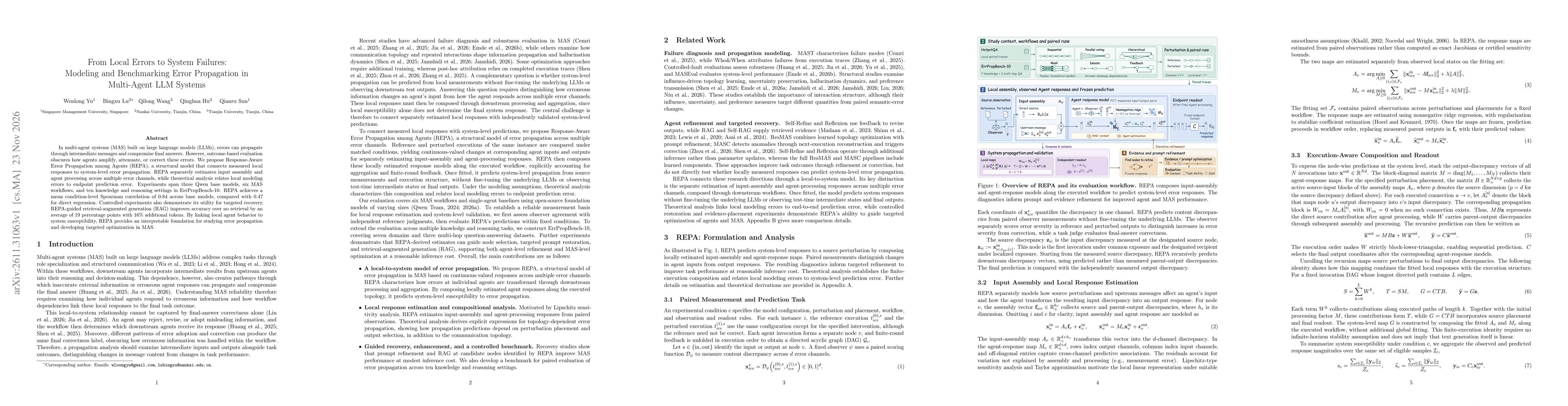
In multi-agent systems (MAS) built on large language models (LLMs), errors can propagate through intermediate messages and compromise final answers. However, outcome-based evaluation obscures how agents amplify, attenuate, or correct these errors. We propose Response-Aware Error Propagation among Agents (REPA), a structural model that connects measured local responses to system-level error propagation. REPA separately estimates input assembly and agent processing across multiple error channels, while theoretical analysis relates local modeling errors to endpoint prediction error. Experiments span three Qwen base models, six MAS workflows, and ten knowledge and reasoning settings in ErrPropBench-10. REPA achieves a mean condition-level Spearman correlation of 0.84 across base models, compared with 0.47 for direct regression. Controlled experiments also demonstrate its utility for targeted recovery. REPA-guided retrieval-augmented generation (RAG) improves accuracy over no retrieval by an average of 19 percentage points with 16% additional tokens. By linking local agent behavior to system susceptibility, REPA provides an interpretable foundation for studying error propagation and developing targeted optimization in MAS.
Analysis
AI-generated · verify against the original paper
Generated Jan 1, 0001ResultsWhat the authors found
- REPA achieves a mean condition-level Spearman correlation of 0.84 across base models, compared with 0.47 for direct regression.
- REPA-guided retrieval-augmented generation improves accuracy over no retrieval by an average of 19 percentage points with 16% additional tokens.
- Controlled experiments demonstrate REPA's utility for targeted recovery such as prompt refinement and node selection.
- REPA can predict system-level error propagation without fine‑tuning the underlying LLMs or observing downstream test outputs.
LimitationsWhere the findings need caution
- Evaluation is limited to three Qwen checkpoints and six MAS workflows, leaving generalization to other model families and dynamic execution structures open.
- ErrPropBench-10 covers a bounded set of knowledge and reasoning domains, limiting broader domain variation.
MethodologyHow the work was done
We propose REPA, a structural model that separately estimates input assembly and agent processing across multiple error channels using paired reference and perturbed executions; theoretical analysis relates local modeling errors to endpoint prediction error; experiments span three Qwen base models, six MAS workflows, and ten knowledge and reasoning settings in ErrPropBench-10.
SignificanceWhy the work matters
By linking local agent behavior to system susceptibility, REPA provides an interpretable foundation for studying error propagation and developing targeted optimization in multi‑agent LLM systems.
Technical contributionsWhat the work introduces
REPA introduces a compositional framework that estimates local responses across multiple error channels and aggregates them along the workflow topology to predict system-level error propagation without additional model fine‑tuning.
NoveltyHow it differs from prior work
First local‑to‑system error propagation model for multi‑agent LLM systems that leverages continuous‑valued paired observations and theoretical composition analysis to connect measured local responses with system‑level susceptibility.
Future workQuestions that remain
- Extend evaluation to heterogeneous agents and adaptive, tool‑using workflows under shared tasks and evaluation protocols.
- Broaden domain coverage and controlled experimental settings to reveal further propagation patterns and relate them to foundation‑model capabilities.
Discussion 0