From Perception to Simulation: Unveiling and Empowering Mental Spatial Dynamics in MLLMs
Abstract
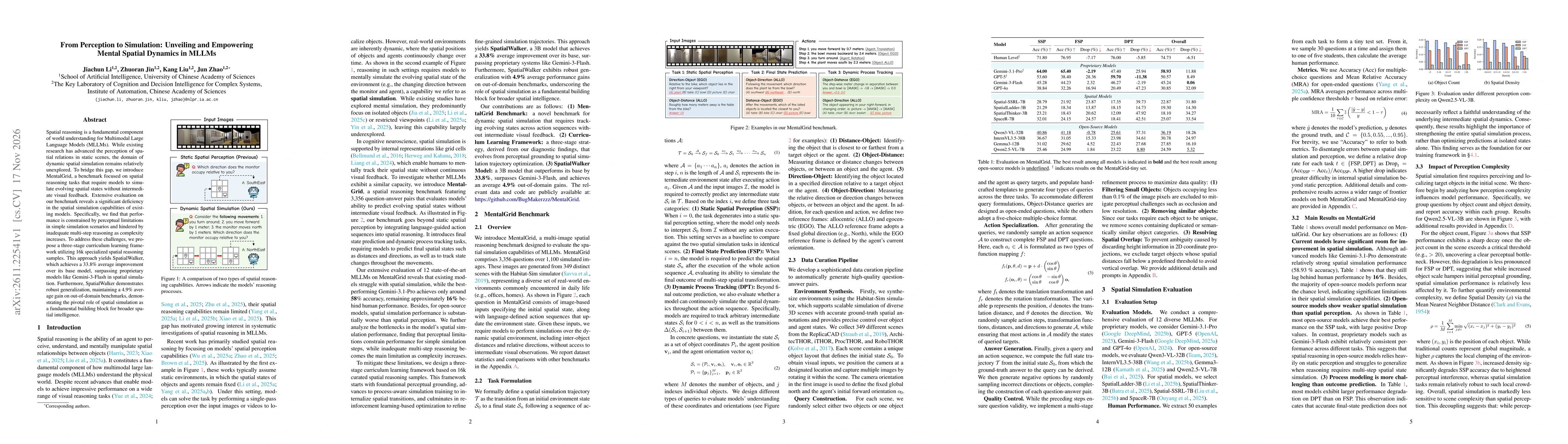
Spatial reasoning is a fundamental component of world understanding for Multimodal Large Language Models (MLLMs). While existing research has advanced the perception of spatial relations in static scenes, the domain of dynamic spatial simulation remains relatively unexplored. To bridge this gap, we introduce MentalGrid, a benchmark focused on spatial reasoning tasks that require models to simulate evolving spatial states without intermediate visual feedback. Extensive evaluation on our benchmark reveals a significant deficiency in the spatial simulation capabilities of existing models. Specifically, we find that performance is constrained by perceptual limitations in simple simulation scenarios and hindered by inadequate multi-step reasoning as complexity increases. To address these challenges, we propose a three-stage curriculum learning framework utilizing 16k specialized spatial reasoning samples. This approach yields SpatialWalker, which achieves a 33.8% average improvement over its base model, surpassing proprietary models like Gemini-3-Flash in spatial simulation. Furthermore, SpatialWalker demonstrates robust generalization, maintaining a 4.9% average gain on out-of-domain benchmarks, demonstrating the pivotal role of spatial simulation as a fundamental building block for broader spatial intelligence.
Analysis
AI-generated · verify against the original paper
Generated Jan 1, 0001ResultsWhat the authors found
- SpatialWalker achieves a 33.8% average improvement over its base model on MentalGrid.
- SpatialWalker surpasses proprietary models such as Gemini-3-Flash in spatial simulation tasks.
- SpatialWalker gains an additional 4.9% average performance on out-of-domain benchmarks.
- The best existing model, Gemini-3.1, reaches only ~58% accuracy, about 16% below human performance.
LimitationsWhere the findings need caution
- Performance is constrained by perceptual limitations in simple simulation scenarios.
- Inadequate multi-step reasoning hampers accuracy as task complexity increases.
MethodologyHow the work was done
The authors introduce MentalGrid, a benchmark of 3,356 QA pairs over 1,100 simulated images requiring models to predict evolving spatial states without intermediate visual feedback. They evaluate 12 state-of-the-art MLLMs on this benchmark, identify performance bottlenecks, and propose a three-stage curriculum learning framework using 16k curated spatial reasoning samples, culminating in the SpatialWalker model.
SignificanceWhy the work matters
The work highlights a critical gap in dynamic spatial simulation capabilities of current MLLMs and demonstrates that targeted curriculum learning can substantially boost spatial intelligence, a foundational skill for broader real-world reasoning.
Technical contributionsWhat the work introduces
The paper contributes the MentalGrid benchmark for dynamic spatial simulation and a three-stage curriculum learning framework that trains MLLMs to better ground perception, simulate spatial transitions, and refine trajectories via reinforcement learning, resulting in the SpatialWalker model.
NoveltyHow it differs from prior work
It is the first study to systematically evaluate and improve mental spatial simulation in MLLMs, moving beyond static perception to dynamic, vision-free spatial reasoning.
Discussion 0