From Sessions to Serving: Integrating LLM-Based Embeddings into Retrieval for Production Content Recommendation
Abstract
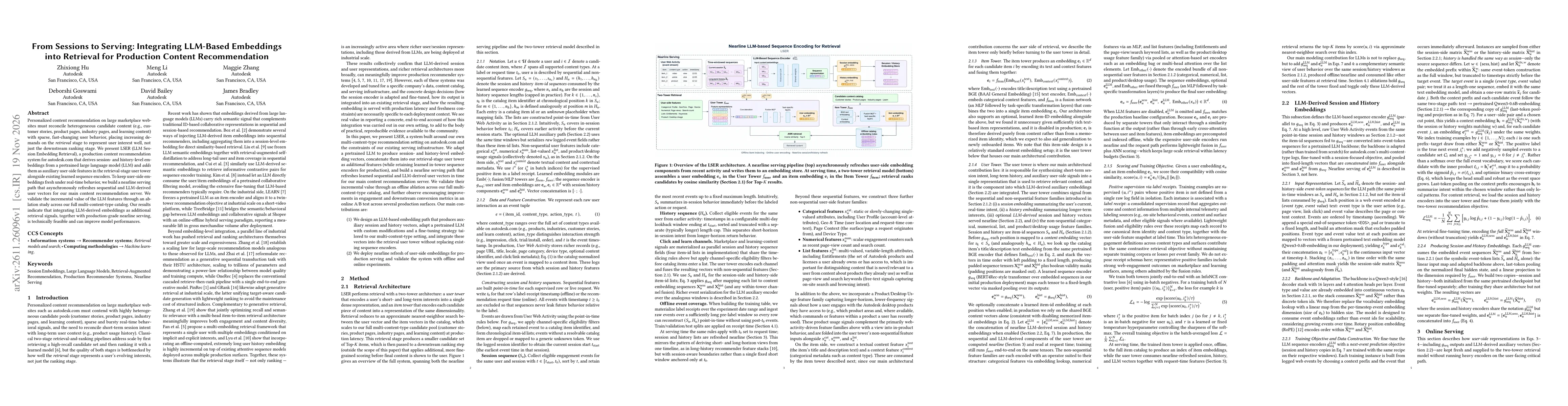
Personalized content recommendation on large marketplace websites must reconcile heterogeneous candidate content (e.g., customer stories, product pages, industry pages, and learning content) with sparse, fast-changing user behavior, placing increasing demands on the retrieval stage to represent user interest well, not just the downstream ranking stage. We present LSER (LLM Session Embedding Retrieval), a production content recommendation system for autodesk.com that derives session- and history-level embeddings from a pretrained large language model (LLM) and adds them as auxiliary user-side features in the retrieval-stage user tower alongside existing learned sequence encoders. To keep user-side embeddings fresh under real-time behavior, we build a nearline serving path that asynchronously refreshes sequential and LLM-derived user vectors for our main content recommendation server. We validate the incremental value of the LLM features through an ablation study across our full multi-content-type catalog. Our results indicate that integrating LLM-derived embeddings as additional retrieval signals, together with production-grade nearline serving, is technically feasible and can improve model performances.
Analysis
AI-generated · verify against the original paper
Generated Jan 1, 0001ResultsWhat the authors found
- Offline ablation shows that adding LLM‑derived vectors improves retrieval metrics such as HitRate@K and MRR on the heterogeneous catalog.
- Online A/B testing reports a 10.3% lift in homepage/product carousel CTR, a 36.1% lift in AutoCAD customer‑story CTR, a 17.1% increase in product trial start rate, a 10.5% rise in trial‑install rate, and a 14.8% boost in product order submission rate, all statistically significant (p<0.05).
LimitationsWhere the findings need caution
- The online experiment did not include an ablation of the LLM features, so the live impact of the LLM embeddings remains unmeasured.
- The approach has only been validated on Autodesk.com; its scalability and effectiveness on much larger platforms with higher traffic and faster‑changing catalogs are uncertain.
- Only a single LLM backbone (Qwen‑3 style) and a next‑event prediction fine‑tuning objective were explored, leaving other architectures and training objectives untested.
MethodologyHow the work was done
We design LSER, a two-tower retrieval system that augments the user tower with session- and history-level embeddings generated by a pretrained LLM. The LLM embeddings are fine‑tuned on a next‑event prediction task and concatenated with existing sequence encoder outputs. A nearline serving pipeline asynchronously refreshes both sequential and LLM‑derived user vectors for the live recommendation server. We evaluate the impact via offline ablation studies across the full multi‑content catalog and an online A/B test comparing the LSER stack to a rule‑based baseline.
SignificanceWhy the work matters
The study demonstrates that integrating LLM‑derived session embeddings as auxiliary retrieval signals is technically feasible at production scale and yields measurable improvements in both user engagement and downstream conversion metrics.
Technical contributionsWhat the work introduces
LSER introduces a production‑grade retrieval stack that incorporates LLM‑generated session and history embeddings as auxiliary features in the user tower, combined with a nearline refresh mechanism that keeps user representations fresh for real‑time recommendation.
NoveltyHow it differs from prior work
It is the first system to integrate LLM‑based session embeddings into a large‑scale retrieval stage with asynchronous nearline serving, demonstrating incremental performance gains across a heterogeneous content catalog in a live e‑commerce environment.
Future workQuestions that remain
- Conduct an online A/B test that toggles the LLM‑derived user vectors to isolate their live contribution.
- Investigate the scalability of the retrieval architecture and nearline serving pipeline on platforms with orders‑of‑magnitude higher request volumes.
- Explore alternative LLM backbones, larger model sizes, and different training objectives such as contrastive or multi‑task learning to further improve embedding quality.
Discussion 0