Functional Depth Is Learned: Isolating the Computation That Layers Produce Only Together
Abstract
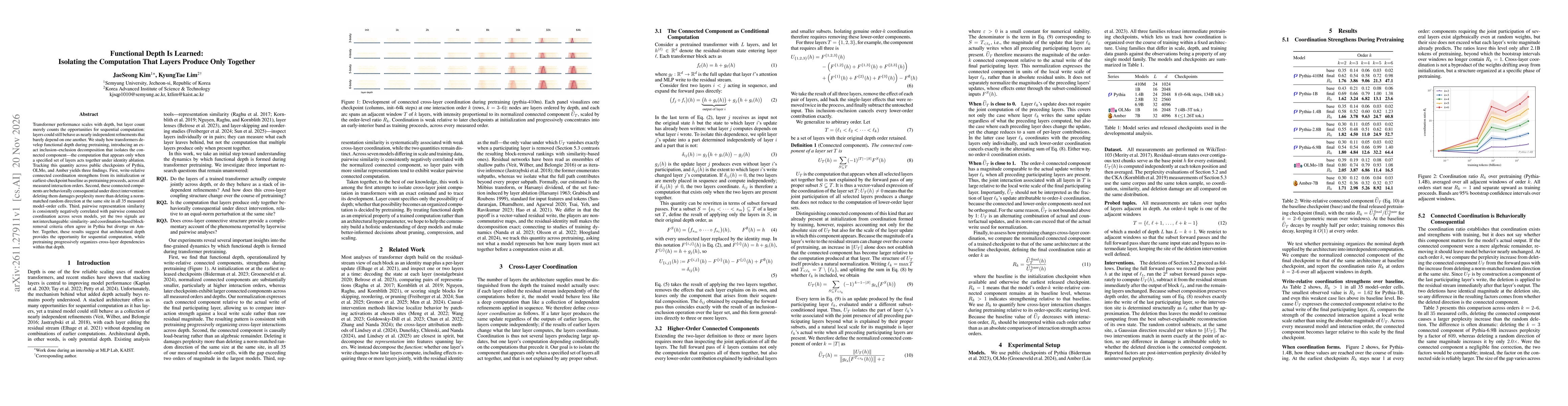
Transformer performance scales with depth, but layer count merely counts the opportunities for sequential computation: layers could still behave as nearly independent refinements that barely depend on one another. We study how transformers develop functional depth during pretraining, introducing an exact inclusion-exclusion decomposition that isolates the connected component, i.e., the computation that appears only when a specified set of layers acts together under identity ablation. Tracking this quantity across public checkpoints of Pythia, OLMo, and Amber yields three findings. First, write-relative connected coordination strengthens from its initialization or earliest-checkpoint baseline as pretraining proceeds, across all measured interaction orders. Second, these connected components are behaviorally consequential under direct intervention: deleting them damages perplexity more than deleting a norm-matched random direction at the same site in all 35 measured model-order cells. Third, pairwise representation similarity is consistently negatively correlated with pairwise connected coordination across seven models, yet the two signals are not interchangeable: similarity- and coordination-based block-removal criteria often agree in Pythia but diverge on Amber. Together, these results suggest that architectural depth provides the opportunity for sequential computation, while pretraining progressively organizes cross-layer dependencies within that depth.
Analysis
AI-generated · verify against the original paper
Generated Jan 1, 0001ResultsWhat the authors found
- Write‑relative connected coordination strengthens from initialization throughout pretraining across all measured interaction orders.
- Deleting the isolated connected component damages perplexity more than deleting a norm‑matched random direction at the same site in all 35 measured model‑order cells.
- Pairwise representation similarity is consistently negatively correlated with pairwise connected coordination across seven models, and similarity‑ and coordination‑based block‑removal criteria sometimes diverge.
MethodologyHow the work was done
The authors introduce an exact inclusion‑exclusion decomposition that isolates the connected component of computation that appears only when a specified set of transformer layers act together under identity ablation. They track this quantity across public checkpoints of Pythia, OLMo, and Amber, and perform direct interventions by deleting the connected component and comparing perplexity impacts to norm‑matched random directions.
SignificanceWhy the work matters
The study demonstrates that architectural depth provides the potential for sequential computation, but pretraining progressively organizes cross‑layer dependencies, revealing functional depth as an emergent property that is behaviorally consequential.
Technical contributionsWhat the work introduces
An exact inclusion‑exclusion (Möbius transform) based estimator that quantifies the computation requiring joint action of multiple layers, enabling precise measurement of functional depth during transformer pretraining.
NoveltyHow it differs from prior work
First work to isolate and empirically trace cross‑layer joint computation in transformers with an exact estimand, linking it to training dynamics and behavioral impact.
Discussion 0