Gaussian Primitive Fusion for Any-Resolution Multimodal Images
Abstract
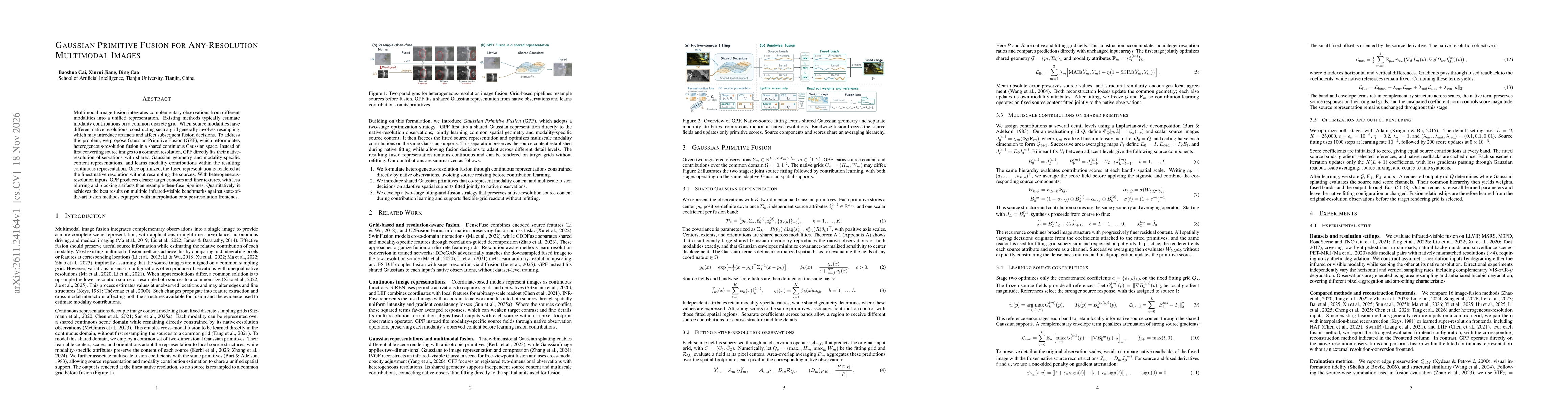
Multimodal image fusion integrates complementary observations from different modalities into a unified representation. Existing methods typically estimate modality contributions on a common discrete grid. When source modalities have different native resolutions, constructing such a grid generally involves resampling, which may introduce artifacts and affect subsequent fusion decisions. To address this problem, we propose Gaussian Primitive Fusion (GPF), which reformulates heterogeneous-resolution fusion in a shared continuous Gaussian space. Instead of first converting source images to a common resolution, GPF directly fits their native-resolution observations with shared Gaussian geometry and modality-specific content representations, and learns modality contributions within the resulting continuous representation. Once optimized, the fused representation is rendered at the finest native resolution without resampling the sources. With heterogeneous-resolution inputs, GPF produces clearer target contours and finer textures, with less blurring and blocking artifacts than resample-then-fuse pipelines. Quantitatively, it achieves the best results on multiple infrared-visible benchmarks against state-of-the-art fusion methods equipped with interpolation or super-resolution frontends.
Analysis
AI-generated · verify against the original paper
Generated Jan 1, 0001ResultsWhat the authors found
- GPF achieves the best quantitative results on multiple infrared-visible benchmarks compared to state-of-the-art fusion methods with interpolation or super-resolution frontends.
- With heterogeneous-resolution inputs, GPF produces clearer target contours and finer textures, exhibiting less blurring and blocking artifacts than resample‑then‑fuse pipelines.
MethodologyHow the work was done
Gaussian Primitive Fusion (GPF) uses a two-stage optimization: first it fits a shared continuous Gaussian representation directly to native-resolution observations, learning common spatial geometry and modality-specific content; then it freezes this representation and optimizes multiscale modality contribution coefficients on the same Gaussian primitives, rendering the fused output at the finest native resolution without resampling.
SignificanceWhy the work matters
By eliminating the need for pre‑fusion resampling, GPF preserves native‑resolution details and improves fusion quality, enabling more accurate multimodal representations for applications such as night‑time surveillance and autonomous driving.
Technical contributionsWhat the work introduces
Introduces shared two‑dimensional Gaussian primitives that jointly encode modality‑specific content and multiscale fusion decisions, and a decoupled fitting‑and‑fusion strategy that maintains native‑resolution information throughout the process.
NoveltyHow it differs from prior work
Reformulates heterogeneous‑resolution multimodal image fusion in a continuous Gaussian space, directly fitting native observations and learning contributions without any prior resampling of source images.
Discussion 0