GazeCode: Recall-Based Verification for Higher-Quality In-the-Wild Mobile Gaze Data Collection
Abstract
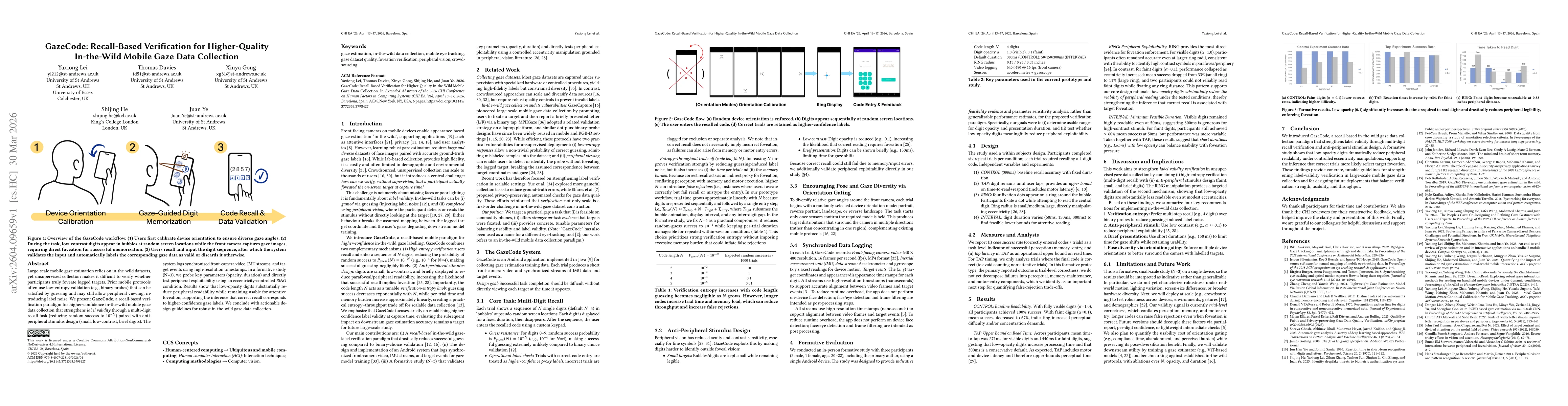
Large-scale mobile gaze estimation relies on in-the-wild datasets, yet unsupervised collection makes it difficult to verify whether participants truly foveate logged targets. Prior mobile protocols often use low-entropy validation (e.g., binary probes) that can be satisfied by guessing and may still allow peripheral viewing, introducing label noise. We present \textbf{GazeCode}, a recall-based verification paradigm for higher-confidence in-the-wild mobile gaze data collection that strengthens \emph{label validity} through a multi-digit recall task (reducing random success to $10^{-N}$) paired with anti-peripheral stimulus design (small, low-contrast, brief digits). The system logs synchronized front-camera video, IMU streams, and target events using high-resolution timestamps. In a formative study (N=3), we probe key parameters (opacity, duration) and directly test peripheral exploitability using an eccentricity-controlled \textit{RING} condition. Results show that low-opacity digits substantially reduce peripheral readability while remaining usable for attentive foveation, supporting the inference that correct recall corresponds to higher-confidence gaze labels. We conclude with actionable design guidelines for robust in-the-wild gaze data collection.
AI Key Findings
Get AI-generated insights about this paper's methodology, results, significance, and more — available when analysis has been generated.
Discussion 0