GenAI-DBT: Evaluating a DBT-Informed Generative AI Platform for Mindfulness Skills Training: A Pilot Randomized Study
Abstract
We evaluated the feasibility, acceptability, and engagement of three digital formats for dialectical behavior therapy (DBT) mindfulness skills training. In a 30-day randomized pilot study, 45 university students were assigned to GenAI-DBT, a general-purpose large language model chatbot (Chatbot), or a static web resource (Web). Forty-two completed the study, and nine completed follow-up interviews. Usability scores were within acceptable ranges across conditions, with no significant between-group differences. GenAI-DBT showed the highest observed participant-week adherence (71.4%, vs. 53.3% for Web and 42.3% for Chatbot), a descriptive difference. Mindful Attention Awareness Scale and Difficulties in Emotion Regulation Scale scores showed no significant time-by-group interactions, and session-level self-reported mood changes did not differ significantly across conditions. GenAI-DBT showed a larger positive change in linguistic valence than Chatbot (4.28 vs. 1.59, P = .02, Cohen's d = 0.99). Interviewees valued contextualized, scenario-based practice and identified response latency, repetition, and limited personalization as areas for improvement. The findings support the feasibility and acceptability of DBT-informed conversational AI for skills practice and motivate further evaluation in larger, more clinically relevant samples. Clinical efficacy remains to be established.
Analysis
AI-generated · verify against the original paper
Generated Jan 1, 0001ResultsWhat the authors found
- Usability scores (SUS) were within acceptable ranges for all conditions with no significant between‑group differences.
- GenAI‑DBT showed the highest participant‑week adherence (71.4%) compared with Web (53.3%) and Chatbot (42.3%).
- No significant time‑by‑group interactions were found for MAAS or DERS scores across conditions.
- GenAI‑DBT produced a larger positive shift in linguistic valence than Chatbot (mean change 4.28 vs 1.59; P = .02; Cohen’s d = 0.99).
- Interviewees valued contextualized, scenario‑based practice but noted response latency, repetition, and limited personalization as areas for improvement.
LimitationsWhere the findings need caution
- Small sample size and pilot nature limit statistical power and generalizability.
- Participants were university students, not a clinical population for which DBT is typically indicated.
- Short 30‑day intervention period may be insufficient to detect clinical efficacy.
MethodologyHow the work was done
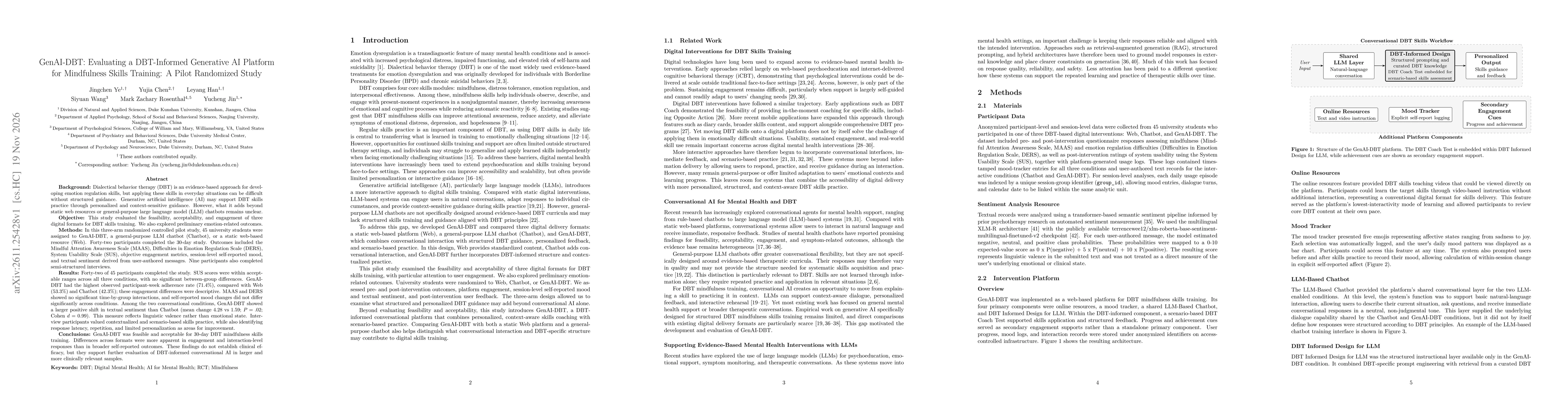
A three‑arm randomized controlled pilot study over 30 days with 45 university students assigned to (1) GenAI‑DBT, a DBT‑informed generative AI chatbot, (2) a general‑purpose LLM chatbot (Chatbot), or (3) a static web‑based resource (Web). Outcomes included the Mindful Attention Awareness Scale (MAAS), Difficulties in Emotion Regulation Scale (DERS), System Usability Scale (SUS), objective engagement metrics (adherence rates), session‑level self‑reported mood, and textual sentiment analysis of user messages. Follow‑up semi‑structured interviews were conducted with nine participants.
SignificanceWhy the work matters
The study demonstrates the feasibility and acceptability of a DBT‑informed conversational AI platform for mindfulness skills practice, suggesting that structured, personalized AI guidance can enhance user engagement beyond static resources or generic chatbots.
Technical contributionsWhat the work introduces
Development of GenAI‑DBT, a conversational AI system that combines DBT‑informed structured guidance, scenario‑based practice, and personalized feedback within a generative language model framework.
NoveltyHow it differs from prior work
First implementation of a DBT‑specific generative AI chatbot for mindfulness skills training, directly comparing its feasibility and engagement against both a static web resource and a general‑purpose LLM chatbot.
Future workQuestions that remain
- Conduct larger randomized trials with clinically relevant samples to assess therapeutic efficacy.
- Refine the platform to reduce response latency, increase personalization, and minimize repetitive content.
- Explore longer‑term outcomes and integration with broader DBT treatment programs.
Discussion 0