Generalized dielectric-dependent hybrid functional combining Gaussian and Yukawa screening
Abstract
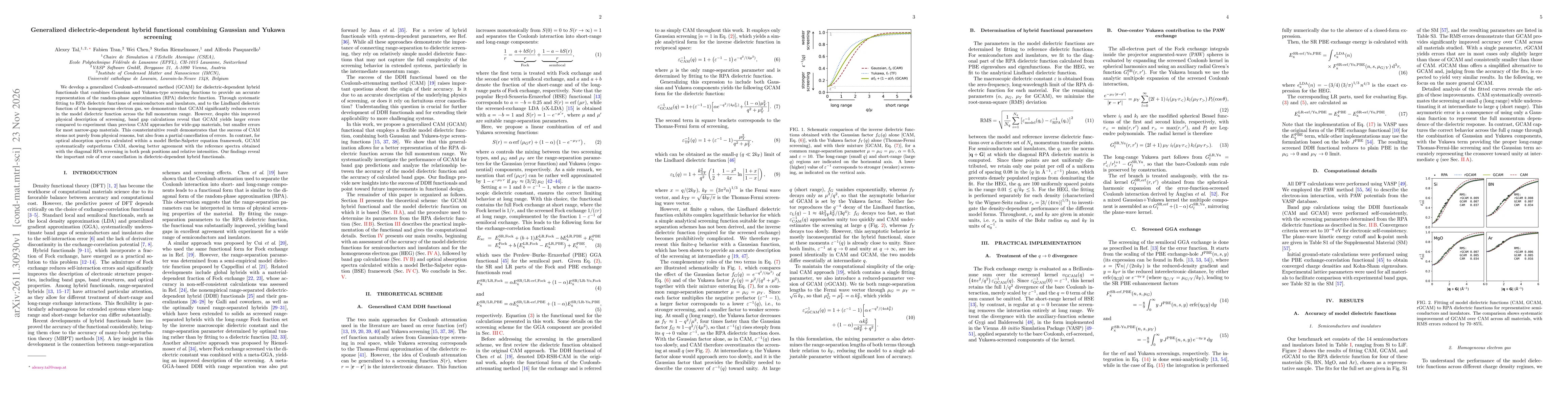
We develop a generalized Coulomb-attenuated method (GCAM) for dielectric-dependent hybrid functionals that combines Gaussian and Yukawa-type screening functions to provide an accurate representation of the random-phase approximation (RPA) dielectric function. Through systematic fitting to RPA dielectric functions of semiconductors and insulators, and to the Lindhard dielectric function of the homogeneous electron gas, we demonstrate that GCAM significantly reduces errors in the model dielectric function across the full momentum range. However, despite this improved physical description of screening, band gap calculations reveal that GCAM yields larger errors compared to experiment than previous CAM approaches for wide-gap materials, but smaller errors for most narrow-gap materials. This counterintuitive result demonstrates that the success of CAM stems not purely from physical reasons, but also from a partial cancellation of errors. In contrast, for optical absorption spectra calculated within a model Bethe-Salpeter equation framework, GCAM systematically outperforms CAM, showing better agreement with the reference spectra obtained with the diagonal RPA screening in both peak positions and relative intensities. Our findings reveal the important role of error cancellation in dielectric-dependent hybrid functionals.
Analysis
AI-generated · verify against the original paper
Generated Jan 1, 0001ResultsWhat the authors found
- GCAM significantly reduces errors in the model dielectric function across the full momentum range compared to previous CAM approaches.
- Band gap calculations show larger errors for wide-gap materials but smaller errors for most narrow-gap materials relative to experiment.
- Optical absorption spectra computed with a model Bethe‑Salpeter equation using GCAM outperform CAM, yielding better peak positions and relative intensities.
LimitationsWhere the findings need caution
- GCAM yields larger band‑gap errors for wide‑gap materials than previous CAM functionals.
- The improved dielectric screening does not automatically translate into uniformly improved band‑gap predictions.
MethodologyHow the work was done
We develop a generalized Coulomb-attenuated method (GCAM) that combines Gaussian (erf) and Yukawa-type screening functions into a single screening function S(r)=α erf(μ_G r)+(1‑α)(1‑e^{-μ_Y r}). The parameters α, μ_G, and μ_Y are fitted to random-phase approximation (RPA) dielectric functions of semiconductors, insulators, and to the Lindhard dielectric function of the homogeneous electron gas, ensuring the correct long-range limit with the macroscopic dielectric constant.
SignificanceWhy the work matters
The study demonstrates that the success of dielectric‑dependent hybrid functionals relies partly on error cancellation, and that a more accurate physical description of screening improves optical properties even when band‑gap predictions are not uniformly better.
Technical contributionsWhat the work introduces
Introduction of a generalized dielectric‑dependent hybrid functional that linearly combines Gaussian and Yukawa screening, with parameters systematically fitted to RPA dielectric data, and its implementation for band‑gap and optical‑absorption calculations.
NoveltyHow it differs from prior work
First hybrid functional that integrates both Gaussian and Yukawa screening functions within a dielectric‑dependent framework, providing a more accurate representation of the RPA dielectric function across all momenta.
Future workQuestions that remain
- Investigate strategies to reduce band‑gap errors for wide‑gap systems while retaining accurate screening.
- Extend the GCAM framework to a broader set of materials and more complex excitonic calculations.
- Explore alternative combinations or parameterizations of screening functions to further enhance error cancellation.
Discussion 0