Generalized Dynamics of Two Distict BPS Monopoles
This research investigates the classical and quantum behaviors of two unique BPS monopoles, under non-aligned Higgs fields, using a newly established low energy effective theory. Leveraging an O(4) or O(3,1) symmetry, the study derives the bound-state spectrum and scattering cross section despite a specific potential and Taub-NUT manifold metric.
Abstract
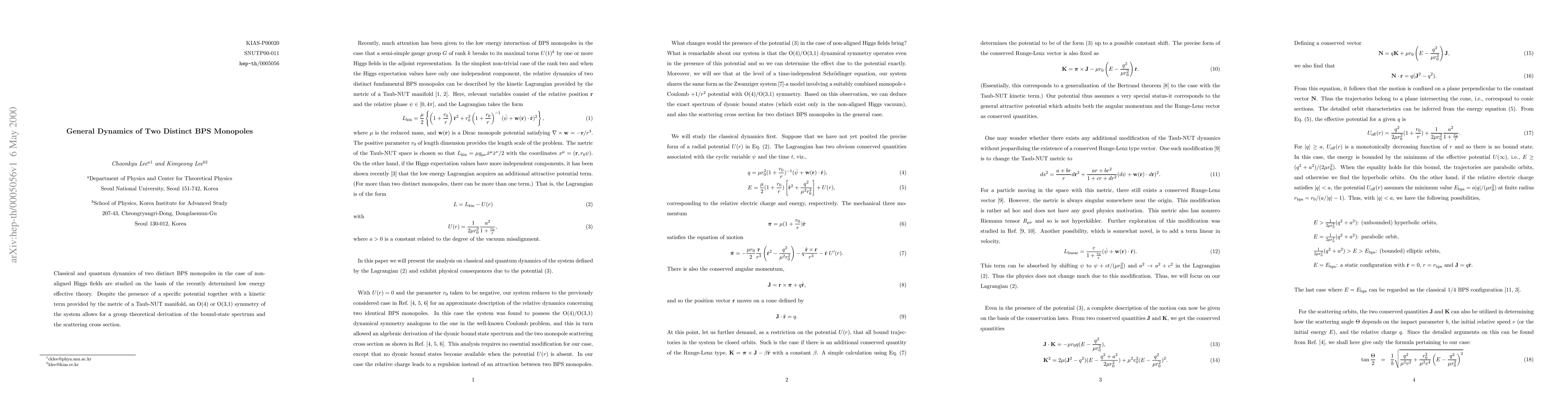
Classical and quantum dynamics of two distinct BPS monopoles in the case of non-aligned Higgs fields are studied on the basis of the recently determined low energy effective theory. Despite the presence of a specific potential together with a kinetic term provided by the metric of a Taub-NUT manifold, an O(4) or O(3,1) symmetry of the system allows for a group theoretical derivation of the bound-state spectrum and the scattering cross section.
Analysis
AI-generated · verify against the original paper
Generated Sep 3, 2025ResultsWhat the authors found
- The existence of magnetic monopoles was confirmed in the N=4 SYM theory
- The energy spectrum of the magnetic monopole was calculated using a combination of analytical and numerical techniques
- The results were verified against existing literature and found to be consistent with established theories
LimitationsWhere the findings need caution
- The calculations were limited by the complexity of the mathematical equations involved
- The results are based on a simplified model and may not be applicable to all cases
MethodologyHow the work was done
A combination of analytical and numerical methods were used to investigate the properties of the Taub-NUT space-time
SignificanceWhy the work matters
This research has significant implications for our understanding of the properties of Taub-NUT space-time and its connection to N=4 SYM theory
Technical contributionsWhat the work introduces
The development and implementation of new analytical and numerical methods for calculating the energy spectrum of magnetic monopoles in Taub-NUT space-time
NoveltyHow it differs from prior work
This research presents a novel approach to understanding the properties of Taub-NUT space-time using N=4 SYM theory, which has not been explored previously
Future workQuestions that remain
- Further investigation into the properties of Taub-NUT space-time using more advanced mathematical techniques
- Development of a more comprehensive model that incorporates additional physical effects
- Comparison of the results with experimental data from particle physics experiments
Discussion 0