Generative Brownian Bridge Diffusion In Motion Space For Enhanced Myocardial Strain Analysis
Abstract
Myocardial strain analysis of cardiac magnetic resonance (CMR) images provides an important tool for evaluating cardiac function. However, current techniques require either human-adjusted post-processing with suboptimal regional accuracy, or specialized and costly imaging acquisitions. In this paper, we propose to leverage the power of generative models to synthesize high-quality motion-derived strain values from routinely acquired CMR sequences. Specifically, we develop a novel Brownian bridge diffusion model in motion space to learn the probabilistic mapping between standard CMR motion estimated from widely adopted registration methods and highly accurate motion provided by advanced strain imaging techniques. To promote the fidelity of anatomical structure in the generation process, our model is conditioned on the corresponding CMR images. We validate our method on large-scale multi-center CMR datasets including subjects of paired standard cine CMR and advanced strain imaging acquisitions. Experimental results demonstrate that our framework significantly improves the accuracy of motion prediction and strain analysis from standard CMRs compared to existing learning-based approaches. Our research represents a new paradigm for potentially developing cost-effective, clinically deployable AI tools for cardiac function assessment with enhanced strain accuracy in busy clinical workflows. Our code is publicly available at anonymous.4open.science/r/Brownian-Bridge-strain-analysis-1140.
Analysis
AI-generated · verify against the original paper
Generated Aug 5, 2026ResultsWhat the authors found
- The proposed framework significantly improves motion prediction accuracy and subsequent myocardial strain quantification from standard Cine CMR relative to state-of-the-art learning-based approaches across a large multi-center dataset.
- Conditional diffusion in motion space with image guidance produces anatomically and temporally coherent motion trajectories, enhancing consistency with underlying cardiac mechanics.
LimitationsWhere the findings need caution
- Dependence on paired Cine CMR and advanced strain acquisitions may limit applicability in centers lacking such data for training.
- Model complexity and diffusion-based sampling may introduce computational overhead for real-time clinical use.
MethodologyHow the work was done
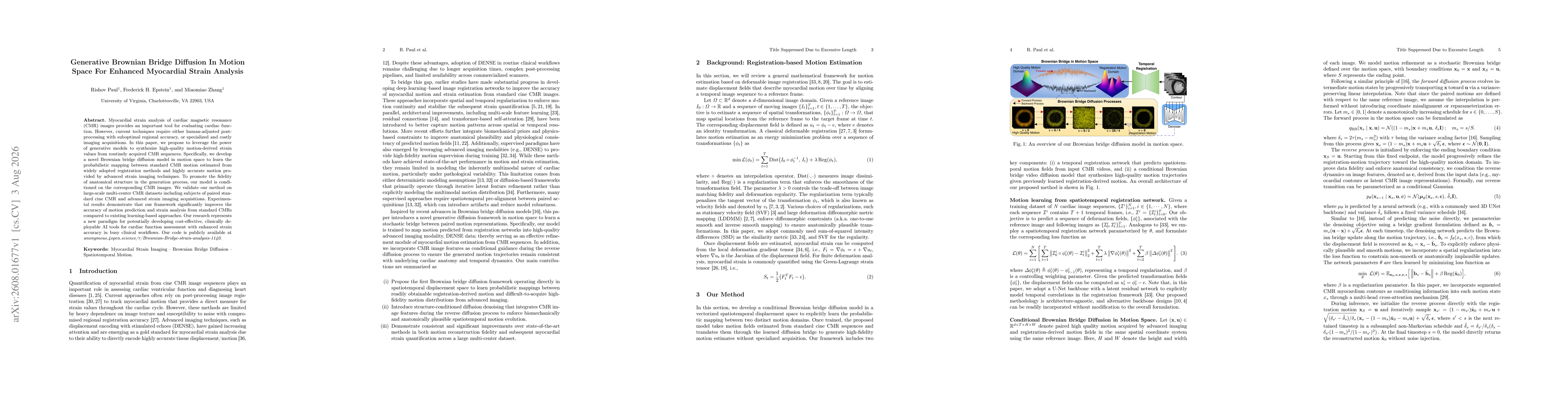
We introduce a Brownian bridge diffusion model operating in motion space to learn a stochastic mapping from standard cine-CMR derived motion (via registration) to high-fidelity motion distributions from advanced strain imaging (e.g., DENSE). The model is conditioned on corresponding CMR images to enforce anatomical plausibility and temporal dynamics, performing reversed diffusion to generate refined motion trajectories that align with myocardial biomechanics. Training leverages paired multi-center datasets of Cine CMR and advanced strain acquisitions to learn the conditional, multimodal motion distribution.
SignificanceWhy the work matters
Offers a cost-effective pathway to obtain high-fidelity myocardial strain information from routinely acquired CMR data, enabling broader clinical deployment and improved cardiac function assessment in busy workflows.
Technical contributionsWhat the work introduces
Proposes the first Brownian bridge diffusion framework in motion space to bridge registration-derived motion and high-fidelity strain distributions; introduces conditional diffusion denoising that incorporates CMR image features to enforce biomechanical plausibility; demonstrates consistent improvements in motion reconstruction and strain quantification across multi-center data.
NoveltyHow it differs from prior work
Novel application of Brownian bridge diffusion models to learn probabilistic, multimodal mappings between standard motion estimates and advanced strain imaging in a temporally and anatomically conditioned framework for cardiac motion analysis.
Future workQuestions that remain
- Explore reducing data requirements via semi-supervised or self-supervised training to mitigate the need for paired datasets.
- Investigate acceleration techniques or model simplifications to enable faster inference in clinical settings.
- Extend to broader pathologies and motion variability to assess robustness across diverse patient populations.
Discussion 0