Generative Poisoning Using Random Discriminators
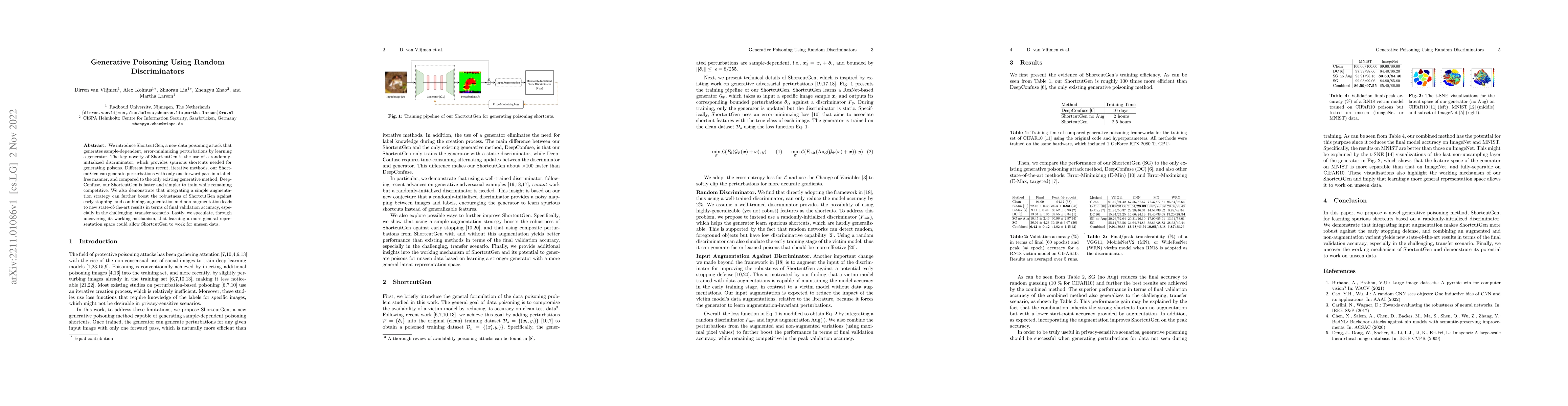
ShortcutGen is a novel data poisoning attack that generates sample-specific, error-minimizing perturbations using a generator and a randomly-initialized discriminator. Unlike iterative methods, it achieves this with a single forward pass and outperforms existing generative methods in speed and simplicity.
Abstract
We introduce ShortcutGen, a new data poisoning attack that generates sample-dependent, error-minimizing perturbations by learning a generator. The key novelty of ShortcutGen is the use of a randomly-initialized discriminator, which provides spurious shortcuts needed for generating poisons. Different from recent, iterative methods, our ShortcutGen can generate perturbations with only one forward pass in a label-free manner, and compared to the only existing generative method, DeepConfuse, our ShortcutGen is faster and simpler to train while remaining competitive. We also demonstrate that integrating a simple augmentation strategy can further boost the robustness of ShortcutGen against early stopping, and combining augmentation and non-augmentation leads to new state-of-the-art results in terms of final validation accuracy, especially in the challenging, transfer scenario. Lastly, we speculate, through uncovering its working mechanism, that learning a more general representation space could allow ShortcutGen to work for unseen data.
AI Key Findings
Get AI-generated insights about this paper's methodology, results, significance, and more — available when analysis has been generated.
Discussion 0