Genetic CFL: Optimization of Hyper-Parameters in Clustered Federated Learning
The paper proposes a genetic clustered federated learning (Genetic CFL) algorithm to optimize hyper-parameters in clustered federated learning, addressing the inefficiencies of client training and static hyper-parameter use. The method clusters edge devices based on training hyper-parameters and employs genetic optimization to enhance cluster accuracy, demonstrating significant improvements on MNIST and CIFAR-10 datasets.
Abstract
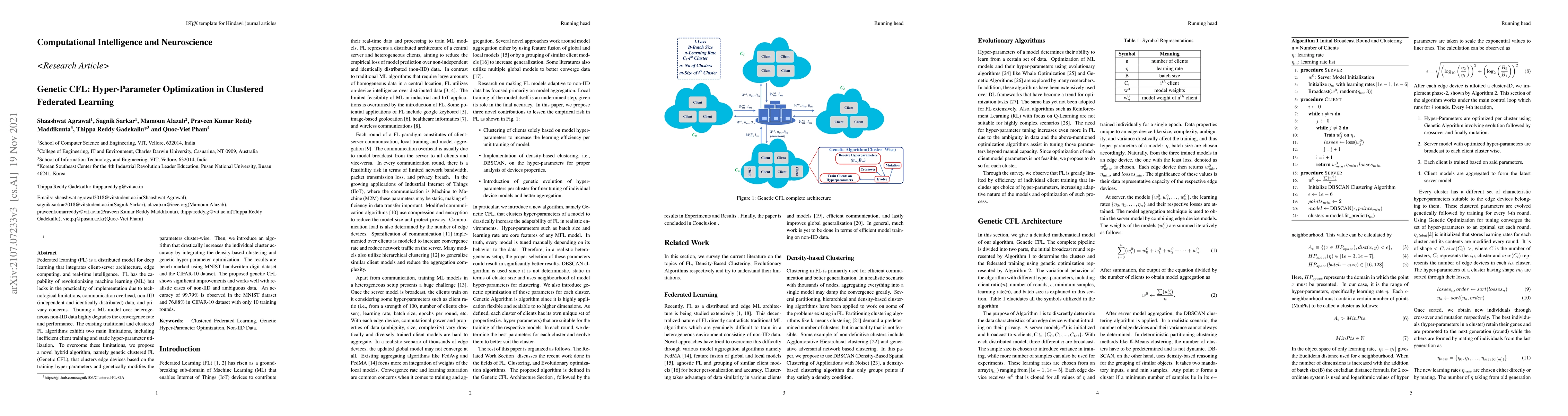
Federated learning (FL) is a distributed model for deep learning that integrates client-server architecture, edge computing, and real-time intelligence. FL has the capability of revolutionizing machine learning (ML) but lacks in the practicality of implementation due to technological limitations, communication overhead, non-IID (independent and identically distributed) data, and privacy concerns. Training a ML model over heterogeneous non-IID data highly degrades the convergence rate and performance. The existing traditional and clustered FL algorithms exhibit two main limitations, including inefficient client training and static hyper-parameter utilization. To overcome these limitations, we propose a novel hybrid algorithm, namely genetic clustered FL (Genetic CFL), that clusters edge devices based on the training hyper-parameters and genetically modifies the parameters cluster-wise. Then, we introduce an algorithm that drastically increases the individual cluster accuracy by integrating the density-based clustering and genetic hyper-parameter optimization. The results are bench-marked using MNIST handwritten digit dataset and the CIFAR-10 dataset. The proposed genetic CFL shows significant improvements and works well with realistic cases of non-IID and ambiguous data.
AI Key Findings
Get AI-generated insights about this paper's methodology, results, significance, and more — available when analysis has been generated.
Discussion 0